
Paneer is a popular ingredient in Indian cuisine and is used in everything from curries and snacks to sandwiches and salads. It is also widely consumed by people looking for a convenient source of protein.
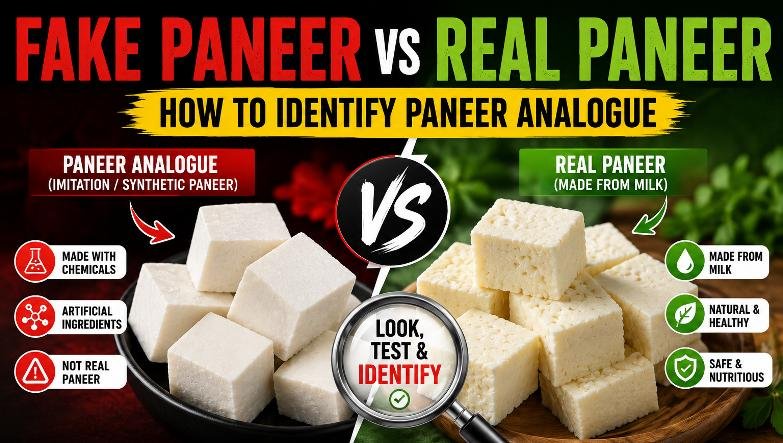
However, growing demand for affordable paneer-like products has also brought attention to paneer analogues, which can contain non-milk ingredients such as vegetable fats, starches, plant proteins and other food ingredients. These products can look and feel similar to paneer but have a different composition and nutritional profile.
It is important to understand that an analogue is not automatically the same thing as adulterated or unsafe food. The key issue for consumers is whether the product is properly labelled and whether they are getting the type of product they believe they are purchasing. FSSAI defines dairy analogues as products in which milk constituents are partly or completely replaced by non-milk constituents.
So, how can you tell the difference between regular paneer and a paneer-like analogue? Here is what consumers should know.
What Is Real Paneer?
According to FSSAI standards, paneer (chhana) is a milk-based product obtained by precipitating milk with permitted acidulants and heating. The standard allows milk and milk solids as raw materials, with permitted acidulants such as lactic acid, citric acid, vinegar and others.
In simple terms, traditional paneer is made by:
- Using milk or permitted milk solids
- Heating the milk
- Adding a permitted acidulant
- Separating the curds from whey
- Pressing the curds to form paneer
Regular paneer therefore has a fundamentally different composition from a product in which major milk components have been replaced with non-milk ingredients.
What Is Paneer Analogue?
A paneer analogue is a paneer-like product in which some or all major milk constituents are replaced with ingredients that do not come from milk.
FSSAI explains that dairy analogues can result when major milk constituents such as milk fat or milk protein are substituted with non-milk ingredients, including vegetable oil/fat or vegetable protein.
Depending on the formulation, a paneer analogue may contain ingredients such as:
- Vegetable oils or fats
- Skimmed milk powder or milk solids
- Starch
- Plant proteins
- Emulsifiers
- Stabilizers
- Processing salts
- Permitted flavours or other ingredients
FSSAI’s 2026 food-safety digest notes that paneer analogues reported in the market can be made using combinations of vegetable oils or fats, milk solids, starches, plant proteins, stabilizers, emulsifiers and flavours.
Real Paneer vs Paneer Analogue
| Feature | Regular Paneer | Paneer Analogue |
|---|---|---|
| Main base | Milk/milk solids | May contain non-milk ingredients |
| Milk fat | Comes from milk | May be partly or fully replaced |
| Plant fat | Not the defining fat source | May be used |
| Plant protein | Not the defining protein source | May be used |
| Appearance | White/cream, firm and soft | Can be designed to resemble paneer |
| Nutritional profile | Based primarily on milk composition | Depends on the ingredients used |
| Label | Paneer/appropriate paneer category | Must follow applicable analogue labelling requirements |
Is Paneer Analogue the Same as Fake Paneer?
Not necessarily.
The term “fake paneer” is commonly used in everyday discussions, but it can be misleading. A dairy analogue can be a deliberately manufactured food product rather than secretly adulterated paneer.
The important distinction is labelling and composition.
If a product contains non-milk ingredients in place of milk constituents, consumers should be able to identify that from the product’s label and ingredient information. FSSAI’s guidance says dairy analogues cannot use milk-product nomenclature in the same way as genuine milk products, and applicable analogue products must follow specific labelling provisions.
Therefore, consumers should not assume that every product containing vegetable fat is automatically dangerous. Instead, check what the product actually contains and how it is labelled.
How to Identify Paneer Analogue
There is no single appearance-based test that can reliably establish whether a product is genuine paneer or an analogue. Texture and appearance can provide clues, but the ingredient list and product label are much more useful for packaged products.
1. Check the Ingredient List
Before buying packaged paneer, look at the ingredients.
Watch for ingredients such as:
- Vegetable oil or vegetable fat
- Palm oil or other vegetable fats
- Plant proteins
- Starch or modified starch
- Emulsifiers
- Stabilizers
- Other ingredients indicating that milk components have been replaced
The presence of these ingredients does not by itself mean the product is unsafe. However, it can indicate that you are buying a paneer-like analogue rather than conventional paneer.
2. Look for the Correct Product Name
Do not rely only on the large product name printed on the front of the package.
Turn the package around and check:
- Product name
- Ingredient list
- Nutritional information
- Manufacturer details
- FSSAI licence information
- Storage instructions
- Batch or lot number
- Manufacturing and expiry/best-before information
FSSAI’s current guidance specifically addresses labelling requirements for dairy analogues.
3. Be Careful With Loose Paneer
Loose paneer can be harder for consumers to evaluate because there may be no ingredient list or detailed product information available.
Whenever possible, buy paneer from a reliable source and choose properly packaged products when you want to check the ingredients and label.
4. Consider Texture and Appearance — But Don’t Rely on Them Alone
Some people use texture as a simple way to distinguish paneer from paneer-like products.
A product that feels unusually:
- Rubbery
- Extremely firm
- Chewy
- Oily
- Artificially smooth
may deserve closer inspection.
However, texture alone cannot prove that paneer is fake or adulterated. Different paneer-making methods, moisture levels and storage conditions can also affect texture.
So, the popular “crumble test” should be treated only as an observation, not as a definitive food-safety test.
Can You Test Paneer at Home?
FSSAI has developed Detect Adulteration with Rapid Test (DART) resources containing simple household tests for certain types of food adulteration. These tests are intended for consumer awareness and screening rather than replacing laboratory analysis.

This is important because a visual or home test cannot identify every possible substitution or processing ingredient.
If you have serious doubts about a food product, the safest approach is to:
- Keep the original packaging and purchase details.
- Check the ingredient and product information.
- Avoid consuming a product that appears spoiled or has an unusual smell or appearance.
- Report suspected food-safety violations to the appropriate food-safety authority.
- For definitive identification, rely on appropriate laboratory testing rather than a single household test.
Why Reading the Label Matters
The easiest habit consumers can develop is to read the label before buying.
A product may look almost identical to paneer while having a significantly different formulation.
| What to Check | Why It Matters |
|---|---|
| Ingredient list | Shows what the product is actually made from |
| Vegetable fat/oil | May indicate replacement of milk fat |
| Plant protein | May indicate replacement of milk protein |
| Starch | Can be used as part of an analogue formulation |
| Product name | Helps distinguish the product category |
| Nutrition information | Helps you compare products |
| Manufacturer details | Helps identify the source |
| FSSAI details | Provides regulatory information |
| Storage instructions | Important for maintaining food quality |
Is Paneer Analogue Less Nutritious?
There is no single nutritional profile for all paneer analogues because formulations can vary significantly.
A product made with vegetable fat, starch and plant protein will have a different nutritional composition from conventional paneer made primarily from milk.
Therefore, rather than assuming that every analogue is “unhealthy,” compare the protein, fat, saturated fat, sodium and calorie values on the nutrition label.
For people who specifically eat paneer as a protein source, this comparison is particularly important.
Tips for Buying Paneer Safely
Keep these points in mind when purchasing paneer:
- Buy from a reliable seller or manufacturer.
- Prefer properly packaged products when you want complete ingredient information.
- Read the ingredient list carefully.
- Check the nutrition information.
- Look for the correct product name and applicable labelling information.
- Check the manufacturing and expiry/best-before details.
- Avoid products with damaged, leaking or suspicious packaging.
- Do not rely solely on colour, smell or texture to identify an analogue.
- If you suspect adulteration, consider reporting it rather than relying on an informal home test.
Final Thoughts
Paneer remains an important part of Indian cuisine, but consumers should be aware of the growing availability of dairy analogue products that can resemble traditional paneer.
The biggest mistake is to assume that every paneer-like product containing vegetable fat is automatically “fake” or dangerous. Instead, consumers should understand the difference between genuine paneer, a labelled dairy analogue and potentially adulterated food.
The simplest way to make an informed choice is to check the product name, ingredient list and nutrition information before buying. When purchasing loose paneer, choose a trustworthy source and be cautious about products whose origin and composition cannot be verified.
For packaged products, the label is often your first and most useful source of information.
Remember: Don’t judge paneer only by its appearance — check what is actually in it.