

World Sanskrit Day is a special occasion dedicated to celebrating Sanskrit, one of the world’s oldest and most influential classical languages. Every year on the day of Shravan Purnima, we celebrate World Sanskrit Day. This day highlights Sanskrit’s extraordinary contribution to Indian literature, philosophy, science, spirituality, education and culture.
- What Is World Sanskrit Day?
- Why is Sanskrit important?
- A Language of Literature and Knowledge
- How Is World Sanskrit Day Celebrated?
- Sanskrit in the Modern World
- World Sanskrit Day and the Younger Generation
- Interesting Facts About Sanskrit
- Frequently Asked Questions About World Sanskrit Day
- Celebrating a Language That Connects Generations
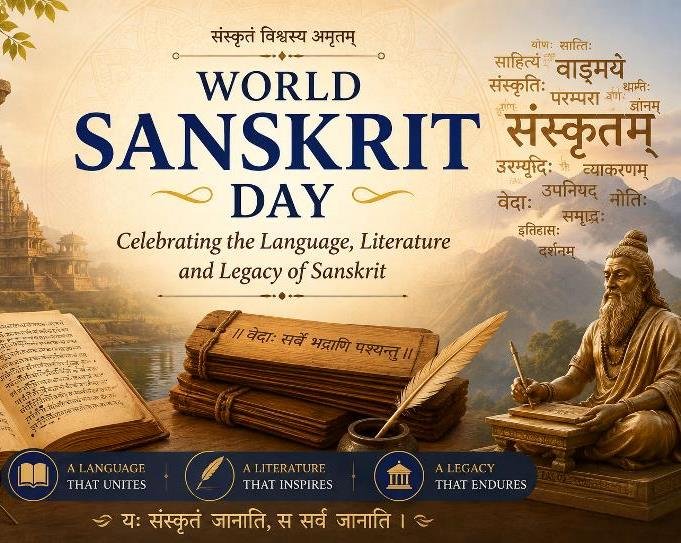
Observed with Sanskrit recitations, cultural programmes, competitions, lectures and educational activities, the occasion encourages people—especially younger generations—to explore the language and its rich heritage.
More than a celebration of an ancient language, World Sanskrit Day is an opportunity to connect India’s cultural past with the present and future.
What Is World Sanskrit Day?
World Sanskrit Day, also known as Sanskrit Diwas, is observed to promote awareness and appreciation of the Sanskrit language. Educational institutions, cultural organisations and Sanskrit scholars often organise programmes to encourage Sanskrit learning and showcase its literary heritage.
The day is particularly significant for students because it provides an opportunity to experience Sanskrit beyond textbooks through:
- Sanskrit poetry and shloka recitations
- Debates and essay-writing competitions
- Cultural performances
- Sanskrit speech programmes
- Lectures by scholars and teachers
- Quiz competitions
- Exhibitions highlighting Sanskrit literature
- Workshops introducing people to basic Sanskrit
Why is Sanskrit important?
Sanskrit has played a major role in the intellectual and cultural history of the Indian subcontinent.
A vast body of literature has been written in Sanskrit, covering subjects ranging from philosophy and religion to mathematics, astronomy, medicine, grammar, drama and poetry.
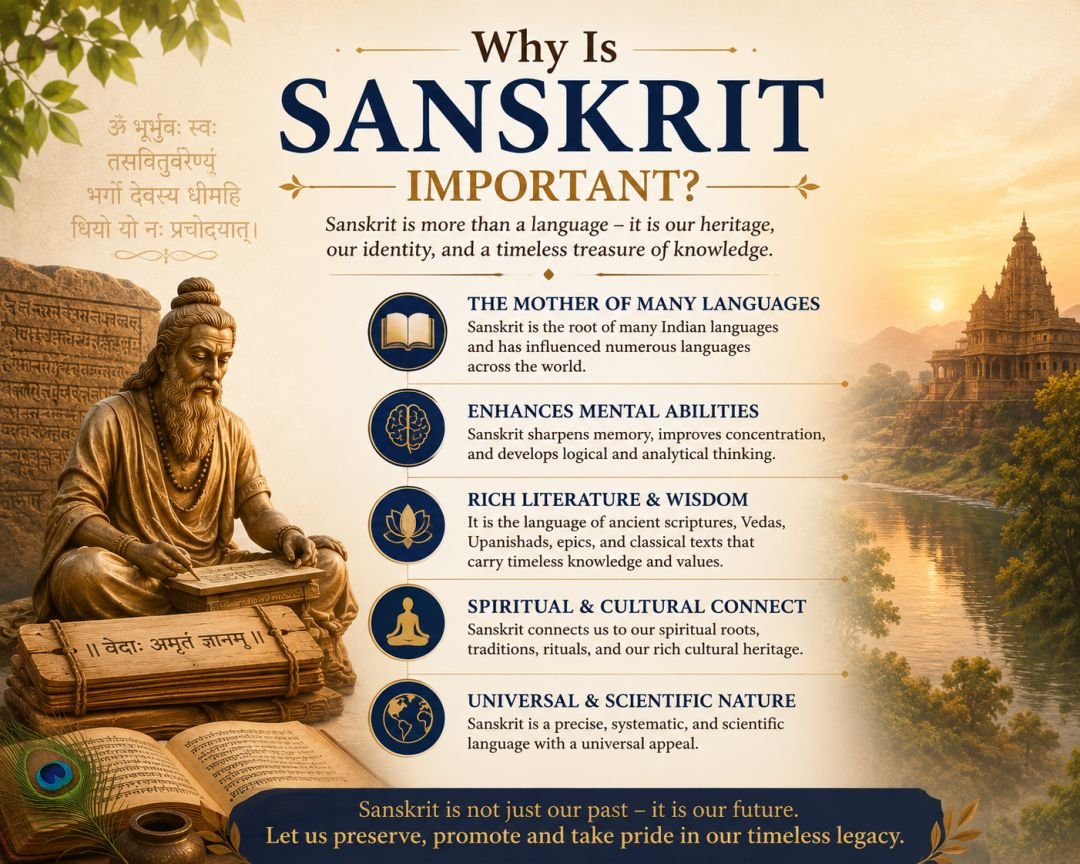
Some of the best-known Sanskrit works and traditions include:
- The Vedas
- The Upanishads
- The Ramayana
- The Mahabharata
- The Bhagavad Gita
- Kalidasa’s literary works
- Panini’s Ashtadhyayi
Sanskrit also influenced the development of several Indian languages and remains an important part of India’s classical literary heritage.
A Language of Literature and Knowledge
One of Sanskrit’s most remarkable features is the enormous range of subjects explored through it.
Ancient scholars composed works on grammar, logic, philosophy, mathematics, astronomy, medicine, politics, linguistics and performing arts.
Panini’s Ashtadhyayi, for example, is widely recognised for its highly systematic treatment of Sanskrit grammar. The work demonstrates the sophisticated linguistic analysis developed in ancient India.
Sanskrit literature also includes celebrated poetry, plays, epics and philosophical texts that continue to be studied today.
How Is World Sanskrit Day Celebrated?
World Sanskrit Day can turn into a lively cultural event when schools, colleges and communities bring the language into everyday activities.
A typical celebration may include a Sanskrit morning assembly, where students recite shlokas or deliver short speeches. This can be followed by quizzes, Sanskrit songs, poetry recitations and traditional performances.
Schools may also organise Sanskrit-themed exhibitions featuring famous scholars, ancient manuscripts, literary works and important milestones in the language’s history.
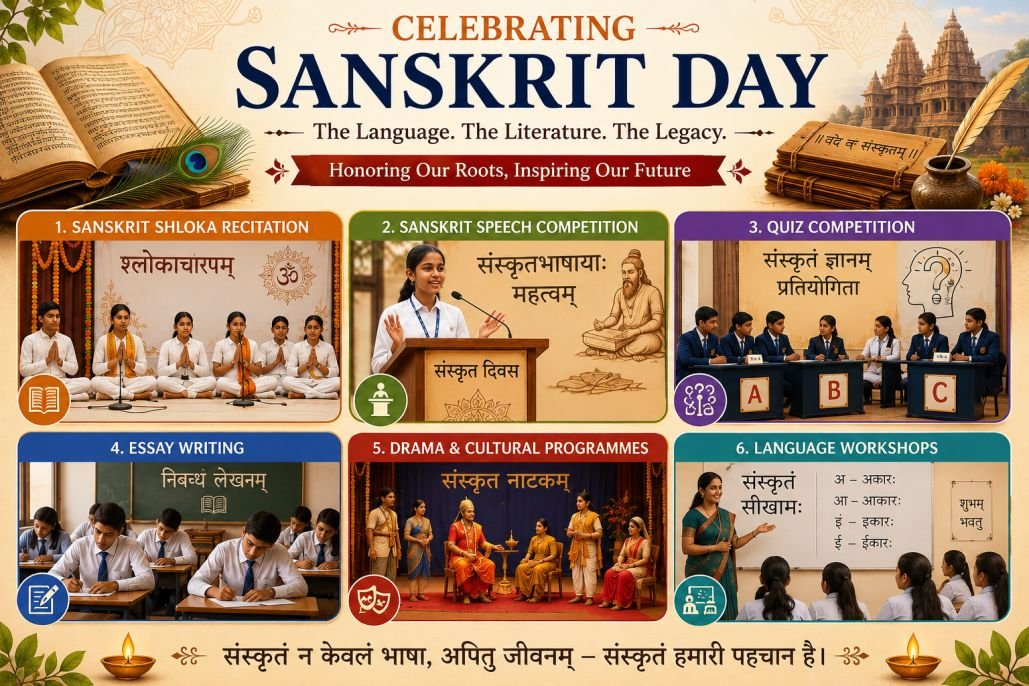
Popular Activities on World Sanskrit Day
- Sanskrit Shloka Recitation – Students present famous verses and explain their meanings.
- Sanskrit Speech Competition – Participants speak about Indian culture, literature or the importance of Sanskrit.
- Quiz Competitions – Questions focus on Sanskrit literature, grammar and famous scholars.
- Essay Writing – Students write about the relevance of Sanskrit in the modern world.
- Drama and Cultural Programmes – Sanskrit plays and traditional performances bring ancient stories to life.
- Language Workshops – Beginners can learn simple Sanskrit words, phrases and sentences.
Sanskrit in the Modern World
Although Sanskrit is an ancient language, its influence continues to be visible in modern India.
Many words used in Indian languages have Sanskrit origins, while Sanskrit terminology is also used in areas such as education, philosophy, yoga, spirituality and traditional knowledge.
Modern technology has also created new opportunities for Sanskrit learning. Digital libraries, online courses, educational applications and searchable archives allow students and researchers to access Sanskrit texts more easily than ever before.
This combination of ancient knowledge and modern technology makes World Sanskrit Day especially relevant today.
World Sanskrit Day and the Younger Generation
For younger people, Sanskrit Day can be more than a traditional school event. It can become an opportunity to discover stories, ideas and knowledge that have survived for centuries.
Interactive activities can make Sanskrit more accessible. Short videos, quizzes, storytelling sessions, pronunciation workshops and social-media content can introduce the language to audiences who may never have studied it formally.
The goal is not simply to preserve Sanskrit as an ancient language but also to encourage curiosity about its literature and intellectual traditions.
Interesting Facts About Sanskrit
- Sanskrit belongs to the Indo-European language family.
- It has a highly developed grammatical tradition.
- Panini’s work on Sanskrit grammar is among the most influential grammatical traditions of the ancient world.
- A large collection of Indian philosophical and literary works was composed in Sanskrit.
- Sanskrit has influenced vocabulary across numerous Indian languages.
- Sanskrit continues to be taught in schools, universities, and traditional institutions.
- Sanskrit is used in many Hindu religious and cultural ceremonies.
Frequently Asked Questions About World Sanskrit Day
When is World Sanskrit Day celebrated?
World Sanskrit Day, or Sanskrit Diwas, is traditionally observed on Shravana Purnima (28 August 2026), the full-moon day of the Hindu month of Shravana. Because it follows the Hindu lunar calendar, its date changes each year on the Gregorian calendar.
Why do we celebrate World Sanskrit Day?
The day is celebrated to promote awareness of Sanskrit, encourage its study and recognise its contribution to Indian literature, culture, philosophy and knowledge traditions.
What is another name for World Sanskrit Day?
World Sanskrit Day is commonly known in India as Sanskrit Diwas or Sanskrit Day.
Who wrote the Ashtadhyayi?
The Ashtadhyayi was composed by the ancient Indian grammarian Panini. It provides a highly systematic framework for describing Sanskrit grammar.
Is Sanskrit still spoken today?
Yes. Sanskrit continues to be studied and used in religious, academic and cultural settings. Some communities and institutions also promote spoken Sanskrit through dedicated programmes and courses.
What are some famous Sanskrit texts?
Important Sanskrit texts include the Vedas, Upanishads, Ramayana, Mahabharata and Bhagavad Gita, along with numerous works of poetry, drama, philosophy, grammar and science.
How can students celebrate World Sanskrit Day?
Students can participate in shloka recitations, Sanskrit speeches, quizzes, essay competitions, dramas, poetry programmes and workshops. They can also learn a few everyday Sanskrit words and explore famous Sanskrit texts.
Why is Sanskrit called an important classical language?
Sanskrit is considered important because of its extensive literary tradition, sophisticated grammatical system and major role in the development of Indian philosophy, literature, religion, arts and intellectual history.
Celebrating a Language That Connects Generations
World Sanskrit Day is a reminder that languages are more than tools of communication—they are carriers of history, ideas and cultural memory.
As celebrations fill classrooms and cultural institutions with Sanskrit verses, stories and performances, the occasion offers a chance to look back at a remarkable literary tradition while asking how it can remain meaningful in the modern world.
World Sanskrit Day celebrates the past, inspires learning in the present and keeps the door open for future generations to discover the richness of Sanskrit.