
The Congress Working Committee (CWC) has decided that only the first two stanzas of Vande Mataram will be sung at party programmes, reviving a decision taken nearly nine decades ago.
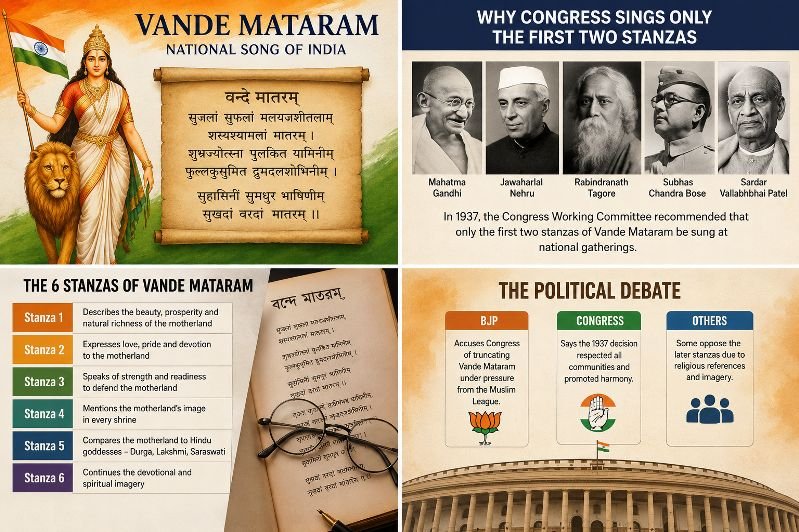
The move comes amid a fresh political controversy over India’s National Song. The BJP has criticised the Congress over its rendition of Vande Mataram at recent programmes, while the Congress has defended its position by referring to a 1937 CWC resolution.
The debate centres on an important question: Why were only the first two stanzas selected, and what do the remaining four stanzas contain?
What Is Vande Mataram?
Vande Mataram, meaning “Mother, I bow to thee”, was written by Bankim Chandra Chattopadhyay in Sanskritised Bengali in 1875. It was later included in his novel Anandamath, published in 1882.
The song became a powerful symbol of India’s freedom struggle, particularly during the Swadeshi movement of 1905–08, when it was widely used as a patriotic slogan and rallying cry.
| Key fact | Details |
|---|---|
| Author | Bankim Chandra Chattopadhyay |
| Composed | 1875 |
| Included in | Anandamath |
| Meaning | Mother, I bow to thee |
| Freedom movement | Prominent during the Swadeshi movement |
| National status | National Song of India |
Why Did Congress Choose Only Two Stanzas in 1937?
The controversy over Vande Mataram is not new. In 1937, Congress leaders debated whether the entire song should be used at national gatherings.
Jawaharlal Nehru expressed concern that parts of the song, particularly when viewed alongside its context in Anandamath, could offend Muslim sentiments. However, he also described some of the opposition to the song as being manufactured by communal forces.
Nehru and Subhas Chandra Bose asked the opinion of Rabindranath Tagore. Tagore distinguished between the first two stanzas and the rest of the composition.
According to Tagore, the first two stanzas had developed an independent patriotic significance and did not contain anything that should offend another community.
The Congress Working Committee subsequently passed a resolution in October 1937, recommending that only the first two stanzas be sung at national gatherings.
What Did Mahatma Gandhi Say about Vande Mataram?
Mahatma Gandhi also supported the historical importance of Vande Mataram but opposed forcing people to sing it.
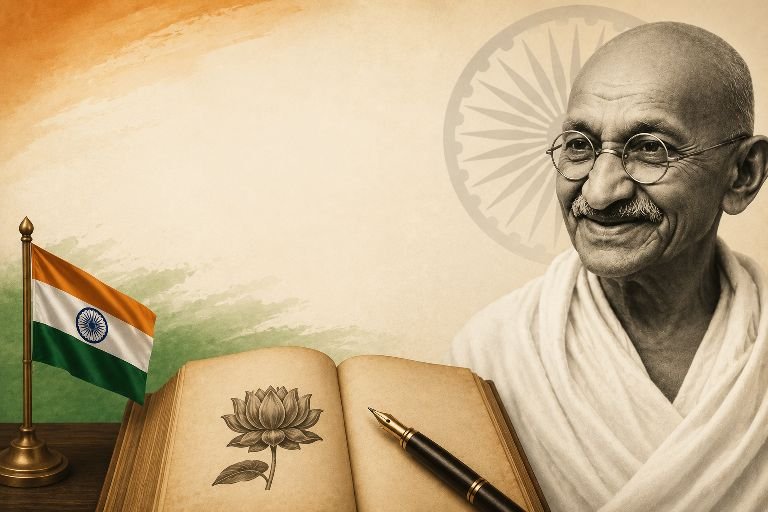
He recalled that the song had served as a powerful rallying cry for both Hindus and Muslims during the anti-Partition movement in Bengal. However, Gandhi believed that no national gathering should turn the song into a source of conflict.
His position was essentially that patriotism should not come at the cost of communal harmony.
What Do the First Two Stanzas Say?
The first two stanzas primarily celebrate the beauty and richness of the Indian motherland.
They describe:
- Fertile land
- Flowing waters
- Green fields
- Cool and pleasant winds
- Natural beauty
- The emotional bond between the people and their motherland
These stanzas are the portion traditionally associated with India’s National Song.
On January 24, 1950, Constituent Assembly President Rajendra Prasad stated that Vande Mataram, because of its historic role in India’s freedom struggle, would be honoured equally with Jana Gana Mana.
What Do the Other Four Stanzas Say?
The remaining four stanzas introduce more explicitly religious and martial imagery.
| Stanza | Major imagery/theme |
|---|---|
| Third | Large numbers of people and arms ready to defend the motherland |
| Fourth | The motherland’s image appearing in shrines |
| Fifth | Comparisons with Hindu goddesses including Durga, Lakshmi and Saraswati |
| Sixth | Further devotional and religious imagery |
It is this section of the song that has historically generated objections among some Muslim scholars and political groups.
Why Are the Later Stanzas Controversial?
The main objection relates to the depiction of Mother India as a divine or goddess-like figure.
Islamic theology strictly rejects the worship of anyone other than Allah. Therefore, some Muslim scholars have argued that the later stanzas’ references to Hindu goddesses can conflict with Islamic beliefs.
The issue is also connected to Anandamath, where the song appears within a story involving armed conflict and religious identity.
Historian Tanika Sarkar has argued that the later portions take on a more explicitly militant character in the context of the novel, with the motherland portrayed as a Hindu goddess.
Why Is the Issue Back in the Political Debate?
The controversy gained renewed attention during Parliament’s discussions in December 2025, held to mark 150 years of Vande Mataram.
Prime Minister Narendra Modi criticised the Congress and Jawaharlal Nehru over the song’s history, arguing that the Congress had curtailed its use under pressure from the Muslim League.
Congress leaders rejected that interpretation, pointing to Nehru’s correspondence and his criticism of communal politics.
The latest CWC decision therefore represents the Congress’s return to the 1937 position: use the first two stanzas while avoiding the portions that have historically generated religious objections.
The Core Debate
- Congress: The first two stanzas were specifically approved for national gatherings in 1937.
- BJP: Congress’s approach reflects a historical compromise that should be reconsidered.
- Supporters of the full song: All six stanzas form the original composition and should be respected.
- Opponents of the later stanzas: The religious imagery can make the song uncomfortable or exclusionary for some communities.
The Vande Mataram debate, therefore, is about more than the length of a national song. It reflects a longstanding tension between historical heritage, patriotism, religious sentiment and India’s commitment to pluralism.