

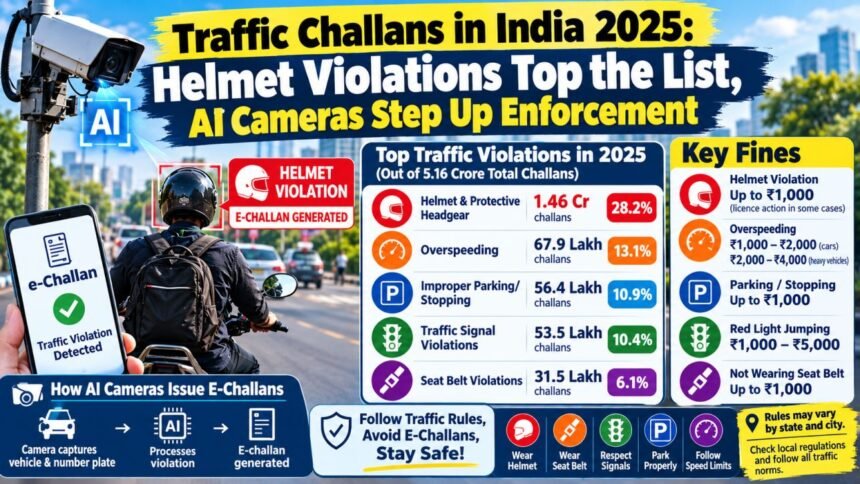
India issued around 5.16 crore traffic challans in 2025, covering a wide range of road safety and traffic violations. Among them, riding without a helmet or protective headgear emerged as the most common offence, accounting for more than a quarter of all challans issued during the year.
- Traffic Challan Rates in India – Quick Info
- Overspeeding Among Major Traffic Violations
- How Much Is the Fine for Overspeeding?
- Seat Belt Violation Can Also Lead to a Challan
- Helmet Violation May Lead to a Fine and Licence Action
- Red Light Jumping Can Attract a Heavy Fine
- How Do AI Cameras Issue E-Challans?
- Traffic Rules and Fines Can Vary by State and City
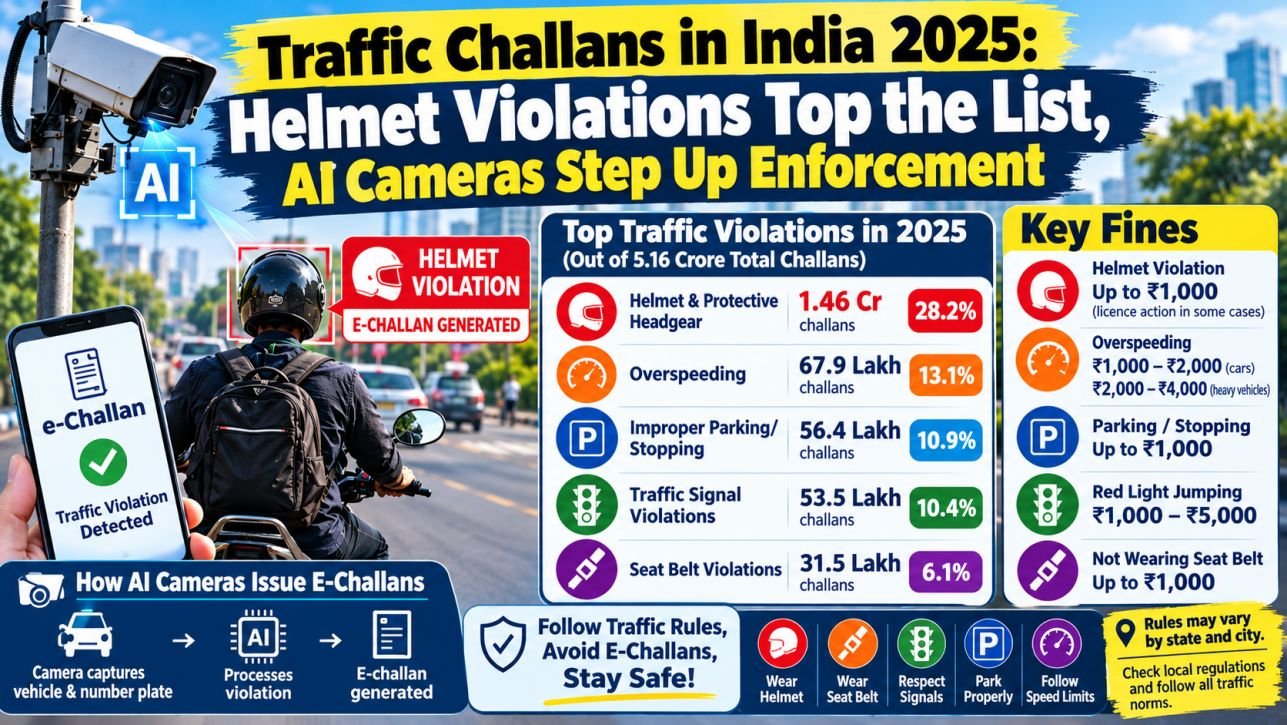
According to data from the Indian traffic enforcement system, around 1.46 crore challans were issued for violations related to helmets and protective headgear. This represented approximately 28.2% of the total challans.
Traffic Challan Rates in India – Quick Info
| Traffic Violation | Possible Fine / Challan |
|---|---|
| 🚫 Driving without a helmet | Up to ₹1,000 |
| 🚗 Not wearing a seat belt | Up to ₹1,000 |
| ⚡ Overspeeding – car/light vehicle | ₹1,000–₹2,000 |
| 🚛 Overspeeding – heavy vehicle | ₹2,000–₹4,000 |
| 🚦 Red light jumping | ₹1,000–₹5,000 |
| 🅿️ Wrong/illegal parking | Varies by location and offence |
| ↔️ Driving on the wrong side | Fine varies according to applicable rules |
Overspeeding Among Major Traffic Violations
Overspeeding was the second-largest category, with around 67.9 lakh challans, accounting for nearly 13.1% of all traffic challans. The average fine in this category was around ₹1,778 per challan.
Improper parking or stopping was another major offence. Authorities issued approximately 56.4 lakh challans for such violations, representing 10.9% of the total. The average penalty was around ₹536 per challan.
Meanwhile, around 53.5 lakh challans were issued for traffic signal violations, making up about 10.4% of all challans. Failure to wear a seat belt resulted in nearly 31.5 lakh challans, or around 6.1% of the total.
How Much Is the Fine for Overspeeding?
The penalty for overspeeding can vary depending on the type of vehicle, the nature of the violation and the applicable traffic rules.
For cars and other light vehicles, overspeeding can attract a fine of around ₹1,000 to ₹2,000 in applicable cases. For heavy vehicles, the penalty may range from ₹2,000 to ₹4,000.
Motorists should therefore pay close attention to speed-limit signs on roads, as the applicable limit and penalty can differ depending on the location and circumstances.
Seat Belt Violation Can Also Lead to a Challan
Not wearing a seat belt is another traffic offence that can result in a fine of up to ₹1,000, according to the information cited in the report.
However, seat belts are important for much more than avoiding a traffic challan. They significantly improve the safety of drivers and passengers during a crash. Wearing a seat belt every time you get into a car should therefore be a basic safety habit.
Helmet Violation May Lead to a Fine and Licence Action
For two-wheeler riders, failing to wear a helmet can result in a fine of up to ₹1,000. In certain cases, action involving suspension of the driving licence may also apply.
Helmet-related safety requirements can also apply to the person travelling as a pillion passenger. Both riders and passengers should follow the applicable helmet rules.
Red Light Jumping Can Attract a Heavy Fine
Jumping a red light is another serious traffic violation. Depending on the applicable rules and circumstances, the penalty can range from ₹1,000 to ₹5,000.
Driving on the wrong side of the road can also lead to enforcement action.
Ignoring a red signal is not just a violation that can result in a challan. It can significantly increase the risk of a collision with vehicles approaching an intersection from another direction.
How Do AI Cameras Issue E-Challans?
Traffic enforcement is becoming increasingly automated with the use of AI-enabled cameras and CCTV systems.
For example, when a vehicle crosses a designated speed limit in front of an enforcement camera, the system can capture the vehicle and record its registration number. The violation can then be processed and an e-challan may be generated.
This means traffic officers do not necessarily have to stop a vehicle at the roadside for every offence. Camera-based systems can also be used to monitor traffic signals and other violations.
Traffic Rules and Fines Can Vary by State and City
While AI-based traffic enforcement is becoming more widespread, the technology used, enforcement process and applicable penalties can vary between cities and states.
Motorists should therefore follow local speed limits and other applicable traffic regulations, including helmet, seat belt, traffic signal and parking rules.
Following these rules not only helps drivers avoid e-challans but also plays an important role in reducing the risk of road accidents.