
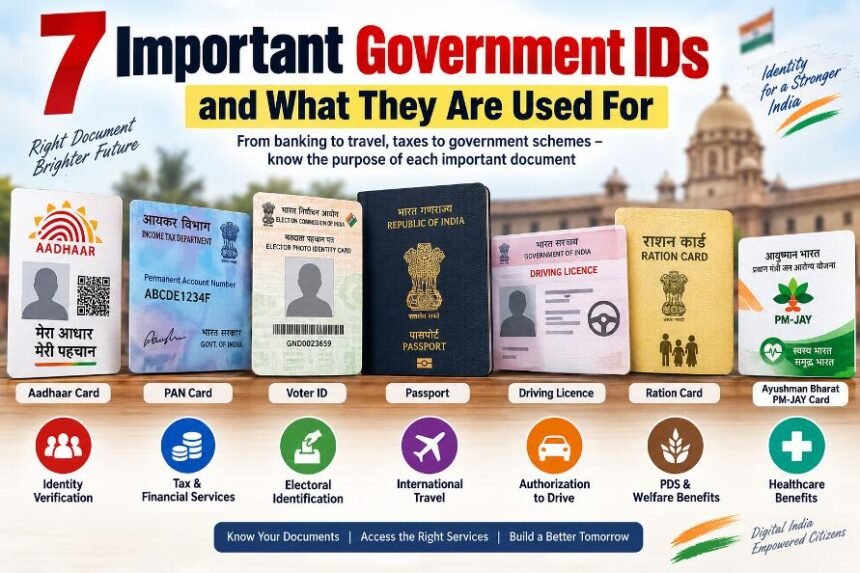
From opening a bank account to filing taxes, booking travel or accessing government services, identity documents have become an essential part of everyday life in India. But with so many different IDs and documents available, it can be confusing to know which one is used for what.
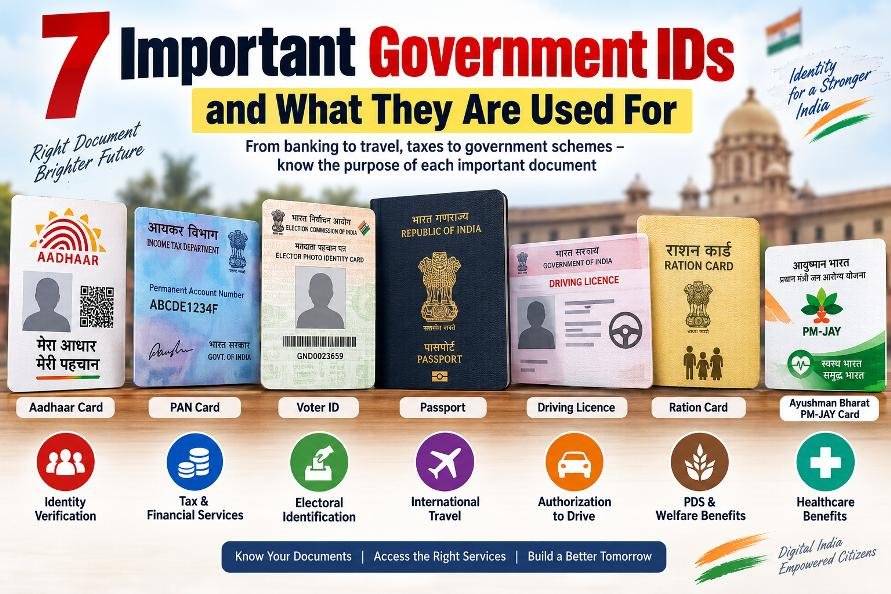
Some documents establish your identity, some are linked to specific government services, while others can also work as proof of address or date of birth.
Here are 7 important government IDs and documents that every Indian should know about—and what they are generally used for.
1. Aadhaar Card
Unique Identification Authority of India issues Aadhaar as a 12-digit unique identification number to residents who meet the applicable enrolment requirements.
It is widely used for identity verification and accessing various government and private-sector services.
Common uses:
- Identity verification
- Accessing government services and schemes
- Mobile SIM verification
- Certain banking and financial services
- Aadhaar-based authentication
Important: Aadhaar is an identity document, but it should not automatically be treated as proof of citizenship.
2. PAN Card
The Permanent Account Number (PAN) is issued by the Income Tax Department.
It is primarily used to identify taxpayers and is important for many financial and tax-related transactions.
Common uses:
- Filing income-tax returns
- Certain high-value financial transactions
- Opening certain financial accounts
- Tax-related documentation
- Tracking tax-linked financial transactions
PAN is particularly important if you earn taxable income or regularly make transactions for which PAN is required.
3. Voter ID
The Voter ID, officially known as the Elector Photo Identity Card (EPIC), is associated with India’s electoral system.
It is used to identify registered voters and is commonly presented as an identity document during elections, subject to applicable election rules.
Common uses:
- Voter identification
- Electoral roll-related services
- Election-related verification
- Identity proof in some situations
Having a Voter ID does not by itself guarantee that a person can vote—the person’s name must be present on the relevant electoral roll.
4. Passport
A passport is issued by the Government of India and is primarily used for international travel.
It is also one of the strongest commonly accepted identity and address documents for many purposes.
Common uses:
- International travel
- Visa applications
- Identity verification
- Address verification
- Immigration procedures
If you travel outside India, your passport is an essential document.
5. Driving Licence
A Driving Licence (DL) is issued by the relevant state or union territory transport authority.
Its primary purpose is to authorize a person to drive specific categories of motor vehicles on public roads, subject to the licence’s conditions.
Common uses:
- Legal authorization to drive
- Identity verification in some situations
- Address proof in some situations
- Vehicle and transport-related services
Remember that a driving licence is not simply an identity card—it confirms that the holder is licensed to drive the specified vehicle categories.
6. Ration Card
A ration card is generally issued by state or union territory authorities and is primarily connected with the public distribution system and welfare-related benefits.
Its exact use and eligibility can vary depending on the state and the type of ration card.
Common uses:
- Access to eligible subsidized food grains
- Public Distribution System services
- Welfare-related identification in certain cases
- Household/family documentation in some situations
The ration card should not be confused with Aadhaar or PAN because it serves a different purpose.
7. Ayushman Bharat PM-JAY Card
The Ayushman Bharat Pradhan Mantri Jan Arogya Yojana (PM-JAY) provides health-coverage benefits to eligible beneficiaries under the scheme.
The beneficiary identification/card is used in connection with accessing eligible healthcare services under the scheme.
Common uses:
- Identifying eligible PM-JAY beneficiaries
- Accessing eligible cashless healthcare services
- Verification at participating hospitals
- Scheme-related healthcare services
Eligibility and benefits depend on the applicable scheme rules and beneficiary status.
Quick Comparison
| ID / Document | Main Purpose | Issuing Authority |
|---|---|---|
| Aadhaar | Identity verification | UIDAI |
| PAN | Tax & financial identification | Income Tax Department |
| Voter ID | Electoral identification | Election Commission of India |
| Passport | International travel & identity | Government of India |
| Driving Licence | Authorization to drive | State/UT Transport Authority |
| Ration Card | PDS & welfare services | State/UT Government |
| PM-JAY Card | Eligible healthcare benefits | National Health Authority / PM-JAY system |
Don’t Keep Every Document in Your Wallet
Having these documents is useful, but carrying the physical originals everywhere isn’t always necessary.
For many services, digital versions or officially accepted alternatives may be available. India’s digital-document ecosystem also allows citizens to access and present certain documents electronically.
If you want to know which apps can make accessing government services and documents easier, check out our guide to Top 5 Government Apps Every Indian Should Have.
However, the exact documents accepted can vary depending on the service, institution and purpose.
Bottom Line
Aadhaar, PAN, Voter ID, Passport, Driving Licence, Ration Card and PM-JAY-related beneficiary documents all serve different purposes. Knowing what each one is actually meant for can save time when applying for services, completing verification or dealing with government procedures.
Before submitting any document, always check which ID or proof the particular service officially requires.