

Prime Minister Narendra Modi on August 15, 2026, unveiled “Shakti Ki Sapta Dhara”, a seven-pillar framework aimed at strengthening India’s economic, technological, strategic and global capabilities on the path towards Viksit Bharat 2047.
- 1. Manufacturing power
- 2. Agriculture and food processing
- 3. Technology and innovation
- 4. Gati Shakti and infrastructure
- 5. Defence self-reliance
- 6. Green and blue economy
- 7. India’s soft power
- Sapta Dhara and Viksit Bharat 2047
- Why Sapta Dhara matters
- Youth at the centre of India’s development agenda
- Sapta Dhara and India’s self-reliance push
- What does Sapta Dhara mean for India?
- Frequently Asked Questions
- Conclusion
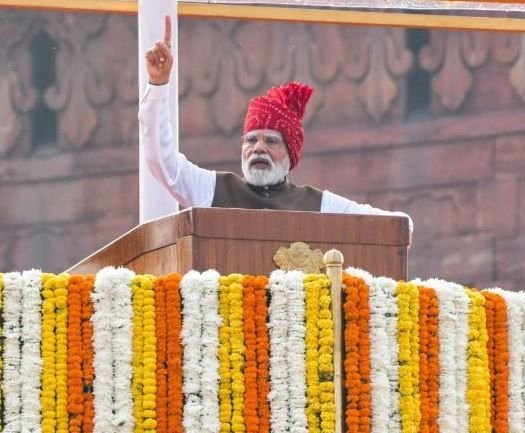
Announcing the framework during his Independence Day speech from the Red Fort, Modi outlined seven key areas: manufacturing, agriculture and food processing, technology and innovation, Gati Shakti and infrastructure, defence self-reliance, the green and blue economy, and India’s soft power.
The Sapta Dhara framework comes as the government continues to focus on self-reliance, advanced technology, manufacturing, employment, national security and sustainable development.
What is Sapta Dhara?
Sapta Dhara, meaning seven streams, is a broad development framework that brings together seven areas considered important for India’s long-term growth and national strength.
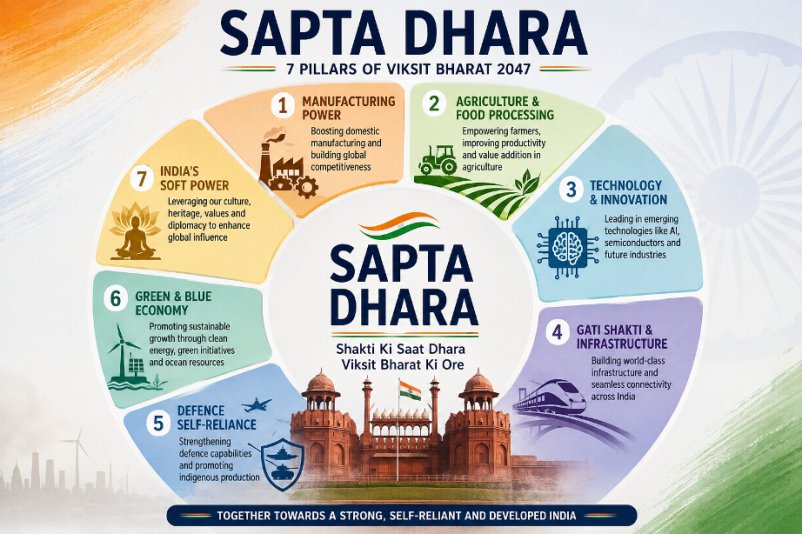
The seven pillars are:
- Manufacturing power
- Agriculture and food processing
- Technology and innovation
- Gati Shakti and infrastructure
- Defence self-reliance
- Green and blue economy
- India’s soft power
The framework is closely linked to the government’s vision of making India a developed nation by 2047, when the country will mark 100 years of independence.
1. Manufacturing power
Manufacturing is the first pillar of Sapta Dhara.
The focus is on increasing domestic production and strengthening India’s manufacturing ecosystem. Greater capacity to produce components and finished products within the country could help India become more competitive in global supply chains.
The manufacturing push is also linked to the broader objective of self-reliance. A stronger industrial base can support investment, exports, employment and technological development.
2. Agriculture and food processing
Agriculture and food processing form the second pillar.
The emphasis goes beyond agricultural production to include processing and value addition. Developing stronger food-processing industries can help farmers access larger markets while reducing wastage and improving the value generated from agricultural products.
Better storage, logistics, technology and market access will remain important to achieving this objective.
3. Technology and innovation
Technology and innovation are the third pillar of Sapta Dhara.
India’s future economic growth is increasingly tied to its ability to develop advanced technologies and build domestic capabilities in emerging sectors.
Artificial intelligence, semiconductors and other high-technology industries have emerged as important priorities. The government has also placed emphasis on expanding AI-related skills among young Indians.
Building a stronger innovation ecosystem could help India create new industries, improve productivity and compete in technology-driven global markets.
4. Gati Shakti and infrastructure
The fourth pillar focuses on Gati Shakti and infrastructure.
Efficient infrastructure is essential for economic growth. Roads, railways, ports, airports and logistics networks help businesses move goods and connect with markets.
The Gati Shakti approach seeks to improve coordination among infrastructure projects and transportation networks. Better connectivity can reduce logistics costs and strengthen the competitiveness of Indian businesses.
5. Defence self-reliance
Defence is the fifth pillar of Sapta Dhara.
The government has increasingly focused on strengthening domestic defence manufacturing and reducing dependence on imports. Indigenous development of defence equipment can also encourage research and advanced manufacturing.
Emerging technologies such as drones, counter-drone systems and hypersonic capabilities are becoming increasingly important to modern warfare.
A stronger domestic defence industry could therefore contribute not only to national security but also to India’s broader technology and manufacturing capabilities.
6. Green and blue economy
The sixth pillar combines the green and blue economy.
The green economy focuses on sustainable development, clean energy and efficient use of resources. The blue economy relates to the sustainable use of marine and ocean resources.
The inclusion of both areas reflects the challenge of pursuing rapid economic development while protecting natural resources and addressing environmental concerns.
For India, sustainable energy, marine resources and climate-conscious economic activity are likely to become increasingly important as the economy expands.
7. India’s soft power
India’s soft power is the seventh pillar.
Unlike manufacturing or defence capabilities, soft power is based on culture, ideas, heritage, diplomacy and international engagement.
India’s cultural traditions, knowledge systems, arts, heritage and growing international partnerships can strengthen its influence around the world.
By including soft power in Sapta Dhara, the framework extends beyond economic and strategic strength to include India’s ability to build international relationships and shape global perceptions.
Sapta Dhara and Viksit Bharat 2047
The seven pillars are part of the broader Viksit Bharat 2047 vision.
The government has set the objective of transforming India into a developed nation by 2047. Achieving that goal will require progress across several areas simultaneously.
Sapta Dhara attempts to bring those priorities together. Manufacturing and agriculture support economic growth, technology drives innovation, Gati Shakti strengthens infrastructure, defence improves strategic capability, the green and blue economy addresses sustainability, and soft power expands India’s global influence.
Why Sapta Dhara matters
The significance of Sapta Dhara lies in its broad approach to national development.
The seven pillars cover several major areas:
- Economic growth: manufacturing and agriculture
- Technology: innovation, AI and emerging technologies
- Infrastructure: connectivity and logistics
- National security: domestic defence capability
- Sustainability: green and blue economic activity
- Global influence: culture, diplomacy and soft power
Together, these priorities form a wide-ranging development agenda for the coming decades.
Youth at the centre of India’s development agenda
Young Indians are also expected to play a major role in the country’s development plans.
The government has highlighted AI skills, education, entrepreneurship, manufacturing and employment as important areas for the country’s large young population.
The expansion of technology-based industries could create new opportunities, but the challenge will be ensuring that young people have the skills needed to participate in these sectors.
Sapta Dhara and India’s self-reliance push
Self-reliance runs through several elements of the Sapta Dhara framework.
Domestic manufacturing can reduce dependence on imported goods and components. Technology development can strengthen India’s capabilities in strategically important sectors, while defence manufacturing can reduce reliance on foreign suppliers.
Agriculture and food processing can also help India capture more value from its own agricultural output.
The broader objective is to create a more resilient economy that can compete internationally while maintaining stronger domestic capabilities.
What does Sapta Dhara mean for India?
Sapta Dhara presents a long-term vision that connects economic development with technology, infrastructure, national security, sustainability and global influence.
Its success, however, will depend on implementation. Achieving the objectives outlined under the seven pillars will require investment, policy execution, skilled workers, infrastructure and cooperation between governments, businesses and other institutions.
The framework provides a broad roadmap, but its eventual impact will be measured by outcomes such as jobs, productivity, exports, technological capability, infrastructure quality and improvements in living standards.
Frequently Asked Questions
What is Sapta Dhara?
Sapta Dhara is a seven-pillar development framework announced by Prime Minister Narendra Modi during his Independence Day address on August 15, 2026.
What are the seven pillars of Sapta Dhara?
The seven pillars are manufacturing, agriculture and food processing, technology and innovation, Gati Shakti and infrastructure, defence self-reliance, the green and blue economy, and India’s soft power.
What is the objective of Sapta Dhara?
Sapta Dhara aims to strengthen key areas of India’s economic, technological, strategic and global capabilities as part of the broader Viksit Bharat 2047 vision.
How is Sapta Dhara linked to Viksit Bharat 2047?
The seven pillars cover major areas considered important for building a developed India, including economic growth, technology, infrastructure, defence, sustainability and international influence.
Why is manufacturing important under Sapta Dhara?
Manufacturing can create jobs, support exports, strengthen domestic supply chains and reduce dependence on imports while increasing India’s industrial capabilities.
Conclusion
Prime Minister Narendra Modi’s Sapta Dhara framework places seven areas at the centre of India’s long-term development strategy: manufacturing, agriculture and food processing, technology and innovation, Gati Shakti, defence, the green and blue economy, and soft power.
The framework adds a broad structure to the government’s Viksit Bharat 2047 vision, bringing together economic growth, technological advancement, infrastructure, national security, sustainability and global influence.
The next challenge will be implementation. The effectiveness of Sapta Dhara will ultimately depend on how successfully these priorities are translated into policies, investment, skills, jobs and measurable results across India.