

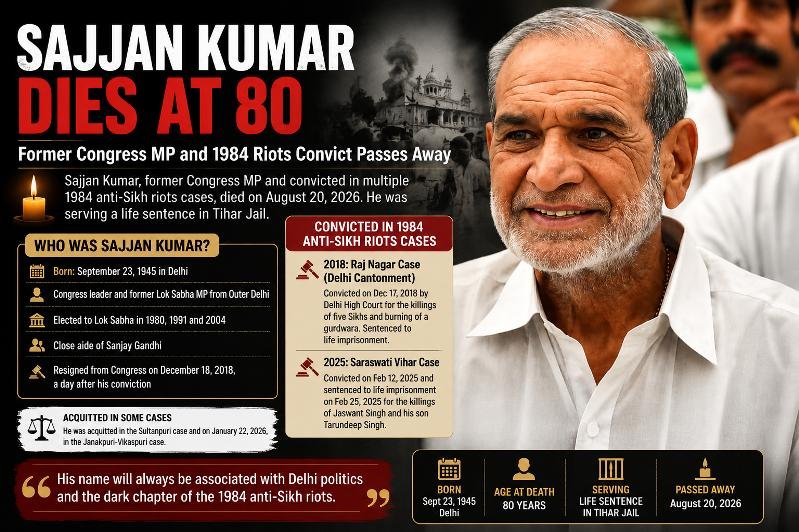
Former Congress MP and senior Delhi leader Sajjan Kumar died on Thursday at the age of 80. According to sources at Safdarjung Hospital in Delhi, Kumar was brought to the hospital, where doctors examined him and declared him brought dead.
His son, Jag Pravesh Kumar, reached Safdarjung Hospital after receiving news of his father’s death.
Sajjan Kumar was serving a life sentence in Tihar Jail after being convicted in cases related to the 1984 anti-Sikh riots. He had been suffering from health-related problems.
Who Was Sajjan Kumar?
Sajjan Kumar was a prominent Congress leader from Delhi who served as a Member of Parliament from the Outer Delhi constituency. Born on September 23, 1945, in Delhi, he entered politics in the 1970s and gradually rose through the Congress ranks.
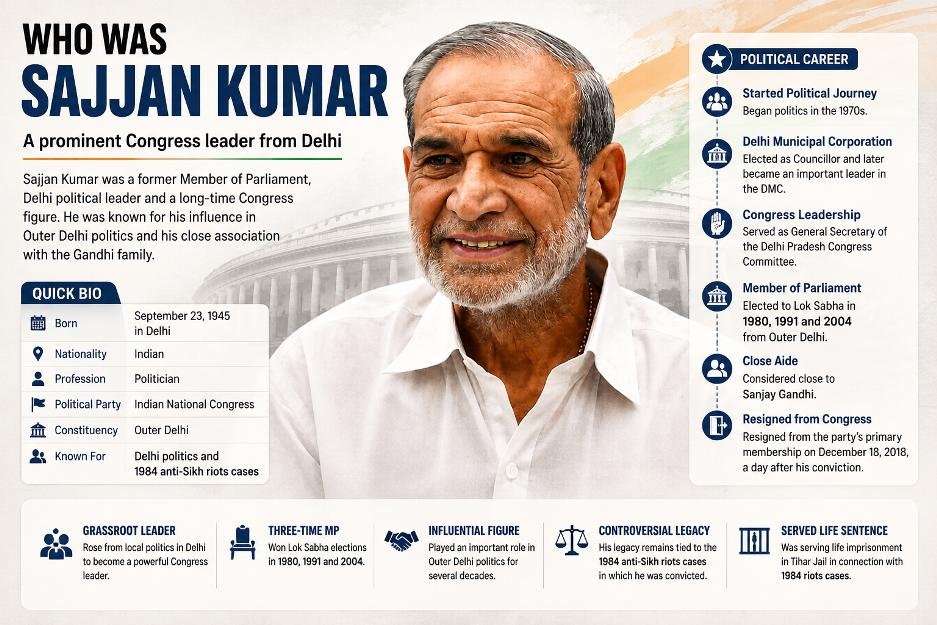
He began his political career as a councillor in the Delhi Municipal Corporation and later served as the general secretary of the Delhi Pradesh Congress Committee.
Kumar was elected to the Lok Sabha in 1980, 1991 and 2004. He was considered close to Sanjay Gandhi and became one of the Congress party’s influential political figures in Delhi.
Following his conviction in a 1984 anti-Sikh riots case in 2018, Kumar resigned from the primary membership of the Congress party.
Sajjan Kumar and the 1984 Anti-Sikh Riots Cases
Sajjan Kumar faced allegations related to murder, incitement of mobs and violence during the 1984 anti-Sikh riots that followed the assassination of then Prime Minister Indira Gandhi.
On December 17, 2018, the Delhi High Court convicted Kumar in the Palam Colony, Raj Nagar case. The case involved the killing of five Sikh members and the burning of a gurdwara. He was sentenced to life imprisonment.
In February 2025, a Delhi court at Rouse Avenue also convicted Kumar in the Saraswati Vihar case concerning the killings of Jaswant Singh and his son Tarundeep Singh. He was again sentenced to life imprisonment.
However, Kumar had also been acquitted in some other cases linked to the 1984 violence, including cases associated with Sultanpuri and Janakpuri-Vikaspuri.
Sajjan Kumar Biography
| Details | Information |
|---|---|
| Full Name | Sajjan Kumar |
| Born | September 23, 1945 |
| Birthplace | Delhi, India |
| Wife | Smt. Ram Kaur |
| Children | Son ‘Jag Pravesh Kumar’ and Two Daughters |
| Political Party | Indian National Congress |
| Profession | Politician |
| Major Political Position | Former Lok Sabha MP |
| Lok Sabha Elections Won | 1980, 1991 and 2004 |
| Constituency | Outer Delhi |
| Known For | Delhi politics and 1984 anti-Sikh riots cases |
| Congress Membership | Resigned in 2018 following conviction |
| Prison | Tihar Jail |
| Sentence | Life imprisonment in 1984 riots-related cases |
| Age at Death | 80 |
| Date of Death | August 20, 2026 |
Political Career of Sajjan Kumar
Kumar emerged as an important Congress leader in Delhi during the 1970s and 1980s. His political influence grew through his work in the Delhi Municipal Corporation and the state Congress organisation.
His electoral victories in the Lok Sabha strengthened his position within Delhi politics, particularly in the Outer Delhi region.
His political career, however, was later overshadowed by legal proceedings connected to the 1984 anti-Sikh riots.
Sajjan Kumar’s Death
Sajjan Kumar was serving his life sentence at Tihar Jail when his health deteriorated. He was taken to Safdarjung Hospital in Delhi, where doctors declared him brought dead.
His death marks the end of the life of a former Congress politician whose career remained closely associated with both Delhi politics and the long-running legal cases arising from the 1984 anti-Sikh riots.
Key Takeaways
- Former Congress MP Sajjan Kumar died at 80.
- He was serving a life sentence in Tihar Jail.
- Kumar was convicted in multiple cases related to the 1984 anti-Sikh riots.
- He represented Outer Delhi in the Lok Sabha.
- He was elected to Parliament in 1980, 1991 and 2004.
- He resigned from the Congress party after his 2018 conviction.
- He was convicted in the Saraswati Vihar case in February 2025 and received another life sentence.