


Germany’s far-right Alternative for Germany (AfD) has secured a landslide victory in the key regional election in Saxony-Anhalt, a former East German state. The result is a major setback for Chancellor Friedrich Merz and his centre-right CDU, but the AfD appears unlikely to secure the absolute majority needed to govern alone.
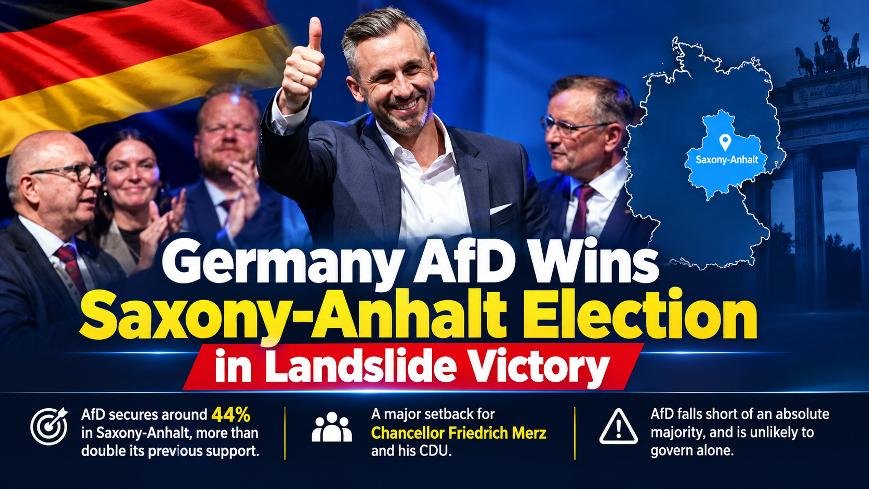
AfD lead candidate Ulrich Siegmund, 35, called the result historic as counting continued. Projections from public broadcasters ARD and ZDF put the AfD at around 44%, more than double its previous support and well ahead of the CDU at about 18%.
CDU state premier Sven Schulze described the result as a “severe blow” but will remain caretaker leader while parties face potentially lengthy negotiations to form a new government.
AfD Wins but Falls Short of Majority
The AfD remains short of an outright parliamentary majority. Germany’s major parties maintain a “firewall” against cooperation with the AfD, meaning they have pledged not to form governing alliances with it.
The AfD’s Saxony-Anhalt branch is classified as right-wing extremist by Germany’s domestic intelligence agency. National AfD co-leader Alice Weidel, who has criticised the firewall as undemocratic, called the result “sensational” and said voters had given the party a clear mandate to govern.
The CDU had hoped to remain in power through a coalition with the SPD, Greens and Die Linke, but even that combination would reportedly fall short of a majority.
The AfD could instead look toward the BSW, a small left-wing party that is tough on immigration and has pro-Russian positions. The BSW was expected to narrowly cross the 5% threshold needed to enter parliament. Weidel said a government involving the BSW was “very interesting” to her party.
Far-Right Government Raises Concerns
A first-ever AfD-led state government would mark a major political shift in Germany, which has remained particularly sensitive to extremist politics because of its history under Nazi rule, World War II and the Holocaust.
Josef Schuster, president of the Central Council of Jews, said he was personally appalled by the election result.
Thousands of AfD opponents rallied in Magdeburg, the state capital, before the election. Protesters carried banners including “life is better without Nazis.” Demonstrator Laura Saalfeld said she feared far-right supporters would feel increasingly comfortable expressing their views openly on the streets.
AfD’s Radical Political Agenda
Siegmund has said he wants to become state premier and use Saxony-Anhalt as a launching pad for an AfD political revolution ahead of Germany’s 2029 national election.
A former entrepreneur with a large social media following, Siegmund attracted enthusiastic supporters during the campaign, with some wearing T-shirts featuring his image. His campaign also appealed to nostalgia for communist-era East Germany, known locally as the “Ossie” identity, and resentment over the continuing economic gap between eastern and western Germany.
Siegmund has frequently ridden the iconic Simson motorcycle, including when travelling to vote.
Despite his relatively friendly public image, his policies are hardline. He has promised a “remigration and deportation offensive” targeting irregular migrants from his first day in office.
The AfD’s wider anti-woke agenda includes replacing LGBTQ pride rainbow flags at public schools with Germany’s national flag and reducing the emphasis on the Third Reich in history education.
AfD Victory Puts Pressure on Friedrich Merz
The election result increases pressure on Chancellor Friedrich Merz, whose government has promised to revive Germany’s sluggish economy and tighten controls on irregular immigration.
The CDU’s poor showing is particularly significant because the party has also been losing ground to the AfD in national opinion polls.
The German Economic Institute has warned that the AfD’s proposed immigration policies could be “ruinous” for Saxony-Anhalt, which depends heavily on workers born outside Germany.