
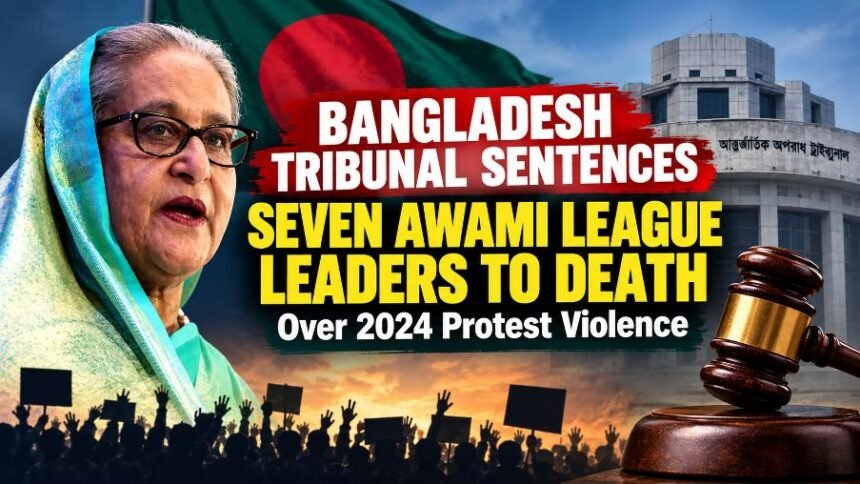
Bangladesh’s International Crimes Tribunal-2 on Tuesday sentenced seven senior leaders of the banned Awami League to death for crimes against humanity linked to the deadly student-led protests of 2024, widely known as the “July uprising.”
The three-member tribunal, headed by Justice Mohammad Nazrul Islam Chowdhury, delivered its verdict after finding the accused responsible for roles including allegedly directing, inciting or facilitating violence during the nationwide demonstrations. All seven defendants were tried in absentia, with government-appointed defence lawyers representing them during the proceedings.
Seven Awami League Leaders Sentenced to Death
Those handed the death penalty include former Road Transport Minister and Awami League General Secretary Obaidul Quader, Joint General Secretary AFM Bahauddin Nasim, and former State Minister for Information and Broadcasting Mohammad Ali Arafat.
The other four convicted leaders are:
- Jubo League Chairman Sheikh Fazle Shams Parash
- Jubo League General Secretary Mainul Hossain Khan Nikhil
- Bangladesh Chhatra League President Saddam Hossain
- Bangladesh Chhatra League General Secretary Sheikh Wali Asif Enan
The case stems from the protests that eventually led to the fall of former Prime Minister Sheikh Hasina’s government on August 5, 2024.
Trial Began in February
The tribunal framed seven charges against the accused on January 22, while the trial formally began on February 17.
Prosecutors alleged that the seven leaders played a role in attempts to suppress the demonstrations by issuing instructions, making inflammatory statements and attending meetings where plans related to violence were allegedly discussed.
The prosecution also accused them of involvement in armed attacks, widespread repression and attempts to control media coverage. According to the case, these actions contributed to killings, attempted killings and large-scale violence across Bangladesh.
Sheikh Hasina Also Received Death Sentence
Sheikh Hasina left Bangladesh for India on August 5, 2024, following the collapse of her government and has remained in India since then.
In November 2025, the tribunal had sentenced Hasina and her former Home Minister Asaduzzaman Khan Kamal to death in absentia over crimes against humanity committed during the crackdown on the student-led protests.
The tribunal found Hasina guilty under the principle of superior command responsibility, concluding that she had authorised the use of lethal force against protesters.
According to estimates from the United Nations human rights office, as many as 1,400 people were killed in violence connected to the protests between July 15 and August 5, 2024.
International Concerns Over Hasina Trial
Hasina’s death sentence previously drew criticism from international human rights organisations and legal experts, who raised concerns about the fairness of the proceedings and the legal process.
Amnesty International criticised the verdict, arguing that the trial and sentence did not ensure justice. Human Rights Watch also expressed concerns about due process, particularly over whether Hasina had been given a genuine opportunity to defend herself through a lawyer of her choice.
The International Crimes Tribunal was originally established by the Hasina government in 2010 to prosecute crimes against humanity committed during Bangladesh’s 1971 Liberation War.
Following the fall of Hasina’s government, the interim administration led by Muhammad Yunus amended the tribunal’s legal framework. The changes expanded its scope to allow action against political parties and organisations associated with alleged crimes.
The latest verdict against seven senior Awami League figures marks another major development in Bangladesh’s continuing legal and political fallout from the 2024 uprising.