
India’s traditional artisans are getting a major push toward modern tools, formal credit and wider markets under the PM Vishwakarma Scheme. Launched on September 17, 2023, the government’s flagship initiative has crossed its target of 30 lakh registered beneficiaries, while millions of artisans have already received training, toolkits, credit and digital-payment incentives.
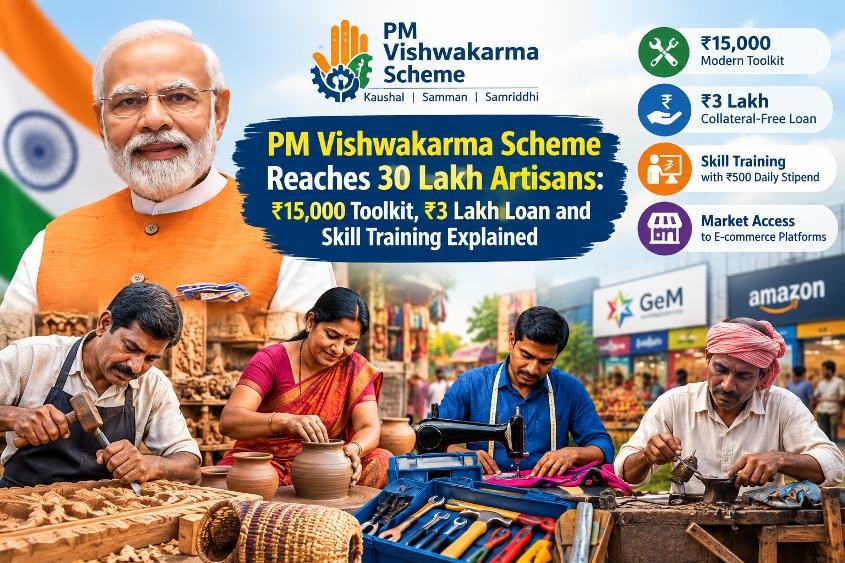
The Central Sector Scheme has an outlay of ₹13,000 crore for 2023-24 to 2027-28 and covers 18 traditional trades. Its objective is to support artisans from skill development and modernisation to financing and market access.
What Is PM Vishwakarma Scheme?
The scheme is built around three pillars — Samman, Samarthya and Samriddhi — and aims to strengthen traditional occupations and the Guru-Shishya parampara.
As of September 15, 2026, more than 24.37 lakh artisans had received basic skill training, while over 18.16 lakh had received modern toolkits.
After registration and verification, beneficiaries receive a PM Vishwakarma Certificate and ID Card. Basic training lasts five to seven days, while advanced training is conducted for 15 days or more. Trainees receive a ₹500 daily stipend.
Eligible beneficiaries can also receive a modern toolkit worth up to ₹15,000.
Up to ₹3 Lakh Collateral-Free Loan
One of the biggest attractions of the scheme is access to affordable business credit.
Artisans can receive collateral-free Enterprise Development Loans of up to ₹3 lakh in two tranches.
- First tranche: Up to ₹1 lakh, with an 18-month tenure
- Second tranche: Up to ₹2 lakh, with a 30-month tenure
- Interest rate: 5%
The government provides interest subvention of up to 8%.
The second loan tranche is linked to repayment of the first tranche and either adoption of digital transactions or completion of advanced training.
So far, more than 6.19 lakh loans worth around ₹5,316 crore have been sanctioned.
Artisans Also Get Digital Payment Incentives
The government is encouraging beneficiaries to bring their businesses into the digital economy.
Artisans receive ₹1 for each eligible digital transaction, subject to a maximum of 100 transactions per month.
More than 8.11 lakh beneficiaries have received digital incentives, with over ₹42 crore disbursed.
The scheme is also introducing artisans to newer technology. More than 12,000 beneficiaries have received training in artificial intelligence tools for branding, product design, packaging and marketing.
Which Trades Are Covered?
PM Vishwakarma covers 18 traditional trades, including carpenters, boat makers, armourers, metalworkers, locksmiths, goldsmiths, potters, sculptors and stone workers, cobblers, masons, basket and mat makers, toy makers, barbers, garland makers, washermen, tailors and fishing-net makers.
The scheme is aimed at artisans aged 18 years or above who work with their hands and tools in a notified trade and are self-employed in the unorganised sector.
Only one member of a family comprising the husband, wife and unmarried children can receive benefits.
From Local Workshops to Amazon and GeM
PM Vishwakarma is not limited to loans and training. The government is also trying to give artisans access to larger markets.
More than 30,000 beneficiaries have been onboarded onto e-commerce platforms, including GeM, ONDC, Meesho, Amazon, Fabindia and Sulekha.
The Ministry of MSME has also signed an MoU with Amazon to facilitate onboarding of eligible artisans.
The first PM Vishwakarma National Exhibition-cum-Trade Fair was held at Dilli Haat from January 17 to 31, 2026. More than 117 artisans participated and recorded sales exceeding ₹2 crore, while the event attracted more than 60,000 visitors.
Evaluation Reports Income Growth
A concurrent evaluation by IIM Mumbai, covering 11,591 beneficiaries across all states and Union Territories, found that 93% of surveyed beneficiaries reported a moderate to significant increase in income after training.
The scheme also includes market-access initiatives through railway stations, airports, exhibitions, trade fairs and other platforms.
With 30 lakh registrations achieved, PM Vishwakarma is increasingly being positioned as a bridge between India’s traditional craftsmanship and modern tools, formal finance, technology and national markets.