

A new UPI payment framework introducing Merchant Discount Rate (MDR) on certain high-value merchant transactions has reached the Supreme Court, with a petition seeking the cancellation of two Finance Ministry notifications issued on September 14 and 15.
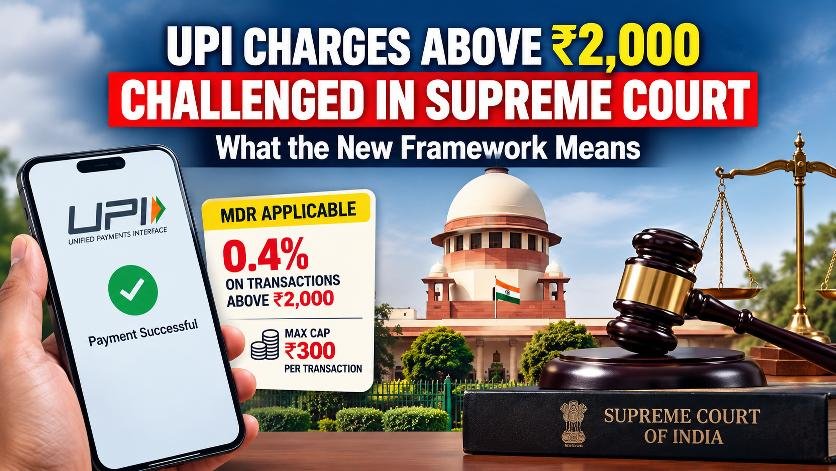
Advocate Anjan Datta has challenged the notifications, arguing that the new framework could eventually have an impact on ordinary citizens. The Union government, Reserve Bank of India (RBI), National Payments Corporation of India (NPCI) and UPI have been named as respondents in the petition.
What Has Changed Under the New UPI Framework?
Under the revised framework, a 0.4% MDR will apply to specified person-to-merchant (P2M) UPI transactions above ₹2,000 from October 15, 2026.
The charge will be capped at ₹300 per transaction. This means that for a transaction of ₹75,000 or more, the maximum MDR will be ₹300.
However, the new MDR is structured as a charge within the merchant payment ecosystem rather than a direct transaction fee collected from consumers.
Will Consumers Have to Pay for UPI?
The Finance Ministry has clarified that person-to-person (P2P) UPI transactions will remain completely free, regardless of the amount transferred.
Payments to merchants up to ₹2,000 will also remain free. The government has further said that eligible small merchants covered under the zero-MDR framework will continue to be exempt.
According to the government’s figures, approximately 96% of all P2M UPI transactions will remain unaffected by the new framework.
Banks have also been advised to ensure that merchants do not pass the MDR cost on to customers.
Why Has the Government Introduced MDR?
The government says the revised framework is intended to support the long-term sustainability, expansion and resilience of the UPI ecosystem, including its infrastructure and related services.
The Finance Ministry has clarified that MDR is not a tax or a charge collected by the government or NPCI. Instead, it is distributed among participants in the payments ecosystem, including banks and payment application providers.
What Is the Supreme Court Petition About?
The petition filed by Anjan Datta challenges the two Finance Ministry notifications that established the revised framework.
The petitioner has sought their cancellation and raised concerns about the possible eventual impact of the new system on the public. The Supreme Court petition names the Centre, RBI, NPCI and UPI as respondents.
At this stage, the filing represents the petitioner’s challenge to the framework; it does not itself mean that the new MDR system has been stayed or cancelled.
What Happens Next?
The new MDR framework is scheduled to come into effect on October 15, 2026, unless there is a subsequent legal or policy change.
For ordinary users, the key point is that P2P UPI transfers remain free, while the new 0.4% MDR applies to specified high-value merchant payments. The government has also said that the vast majority of merchant transactions will remain outside the new charge.