
The Election Commission of India (ECI) is facing fresh scrutiny after an investigation by The Indian Express reported that Election Commissioners Sukhbir Singh Sandhu and Vivek Joshi formally raised objections at least 14 times over a 10-month period concerning decisions and orders related to electoral-roll management.
- ECI Says Final Decisions Were Unanimous
- What Did the Indian Express Investigation Find?
- Controversy Over Form 6
- Questions Over Electoral-Roll Database
- West Bengal and Goa Issues Also Raised
- SIR and the Large-Scale Revision of Electoral Rolls
- Opposition Reacts to Election Commission Report
- What Does the Law Say About ECI Decisions?
- What Is the Controversy About?
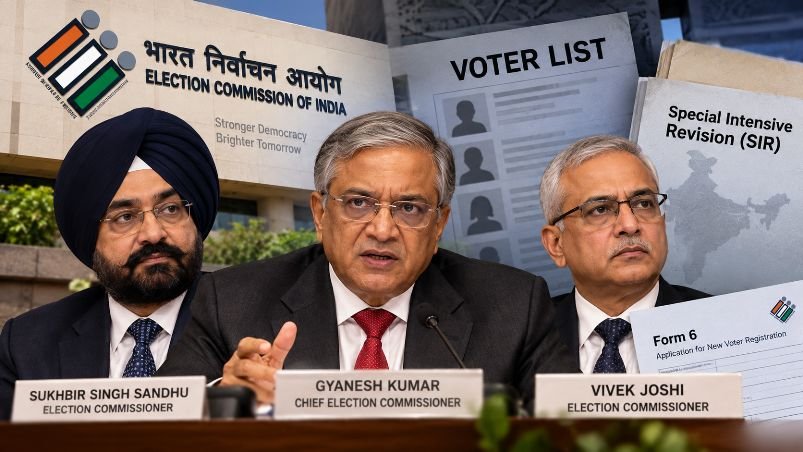
The objections reportedly covered issues including the registration of new voters, deletion and restoration of names from electoral rolls, appeals linked to the Special Intensive Revision (SIR), changes to Form 6 and access to the electoral-roll database. The report said the two commissioners objected that some decisions or instructions had been issued without their knowledge or approval.
The Election Commission, however, has rejected the suggestion that there was a disagreement over its final decisions. ECI sources said that all decisions, including those concerning SIR, were taken unanimously with the approval of Chief Election Commissioner Gyanesh Kumar and both Election Commissioners.
ECI Says Final Decisions Were Unanimous
The clarification came after the Indian Express report triggered questions about the functioning of the three-member poll panel.
According to ECI sources cited by PTI, Sandhu and Joshi had raised concerns over issues such as the deletion of names from electoral rolls in different states and the handling of voter data.
The Commission’s position is that raising concerns or making observations during the process did not mean that the final decisions were taken without the commissioners’ approval.
ECI sources have maintained that decisions relating to SIR and other matters were unanimous and had the approval of all three members of the Commission.
What Did the Indian Express Investigation Find?
According to The Indian Express, Sandhu and Joshi recorded at least 14 formal objections in 10 months, with as many as four objections recorded on a single day.
The objections reportedly concerned several aspects of electoral-roll administration rather than one single issue.
These included:
- Registration of new voters
- Deletion and restoration of names from electoral rolls
- Appeals related to voter inclusion and SIR decisions
- Changes made to Form 6
- Access to and control of the electoral-roll database
- The custody and security of electoral-roll data
The report said the objections were also copied to CEC Gyanesh Kumar, while some were sent to Deputy Election Commissioners.
Controversy Over Form 6
One of the reported disputes involved Form 6, the application used by people to register as new voters.
The Indian Express reported that the form was modified to include questions related to the previous Special Intensive Revision. Applicants were asked whether their name, or the name of a parent or grandparent, appeared in the electoral roll from the previous SIR.
According to the report, Vivek Joshi objected to the change in May, arguing that Form 6 was prescribed under the electoral rules and could not be altered without amending the relevant rules. Sandhu later supported the objection.
The report said the new declaration remained on the online form until September 21.
Questions Over Electoral-Roll Database
Another area of concern involved the digital systems used to manage electoral rolls.
According to The Indian Express, Joshi raised concerns in May about what he described as the gradual centralisation of the electoral-roll database. He proposed an audit to ensure that only the relevant statutory authorities had the credentials required to make changes to the database.
Sandhu subsequently raised similar concerns, saying that state-level election officials were reporting inadequate access to the digital system used for maintaining electoral rolls.
The report also said the two commissioners questioned the authority of the Election Commission’s IT officials to restrict access available to statutory election authorities.
West Bengal and Goa Issues Also Raised
The reported objections also extended to electoral-roll matters in West Bengal and Goa.
In West Bengal, Sandhu questioned the process behind appeals seeking deletion of voters whose names had been retained after scrutiny. According to the report, he sought clarification on who had authorised those appeals and how they were filed.
In Goa, the investigation reported a software-related issue involving 97 voters who had been found eligible but could not be added to the final electoral roll. The case became another example cited in the wider dispute over the functioning of the electoral-roll technology.
SIR and the Large-Scale Revision of Electoral Rolls
The Special Intensive Revision began in Bihar in June 2025 before being expanded to other parts of the country.
The exercise has involved extensive verification and revision of electoral rolls. According to The Indian Express, more than 13 crore names were removed from voter lists and draft electoral rolls across 30 states and Union Territories during the three phases of the exercise.
The scale of the exercise has already generated political and legal debate, particularly over voter deletions, inclusion of eligible voters and the appeals process.
The reported internal objections have added another dimension to that debate because they concern how certain decisions connected with electoral-roll management were handled within the Commission itself.
Opposition Reacts to Election Commission Report
The Indian Express investigation prompted sharp reactions from opposition parties, which have already been challenging the ECI’s handling of the SIR process.
Congress leader Manish Tewari questioned how the credibility of the Election Commission could be restored and said the reported objections raised serious concerns.
Other opposition leaders also criticised CEC Gyanesh Kumar and demanded greater scrutiny of the reported decisions. Congress MP Mohamed Javed, for example, called for the CEC to disclose the disputed decisions and explain who authorised them.
Opposition parties have separately alleged that the SIR process could result in eligible voters being excluded from electoral rolls. Those are political allegations, while the ECI has maintained that the revision is part of its process of updating and verifying electoral rolls.
What Does the Law Say About ECI Decisions?
The Election Commission is a constitutional body under Article 324 of the Constitution of India.
Section 18 of the Chief Election Commissioner and Other Election Commissioners (Appointment, Conditions of Service and Term of Office) Act, 2023, provides that the Commission’s business should, as far as possible, be conducted unanimously. Where the members disagree, the matter is decided according to the majority view.
This provision is relevant to the current controversy because the reported objections concern whether certain communications and decisions were issued with the required approval of the Commission.
At the same time, the ECI has rejected the suggestion that its final decisions were taken without consensus, saying that decisions including those concerning SIR were unanimous.
What Is the Controversy About?
The current dispute involves two separate aspects of the Election Commission’s functioning.
On one side, The Indian Express has reported that Sandhu and Joshi recorded 14 formal objections over 10 months, saying they had not been consulted or informed about certain decisions and orders. The objections covered several electoral-roll and administrative matters.
On the other side, ECI sources have said that these concerns did not amount to dissent over the Commission’s final decisions and that all decisions, including those related to SIR, were taken unanimously.
The competing accounts have now placed the Election Commission’s internal decision-making process under increased public and political scrutiny, particularly as the SIR exercise continues to affect electoral rolls across the country.