
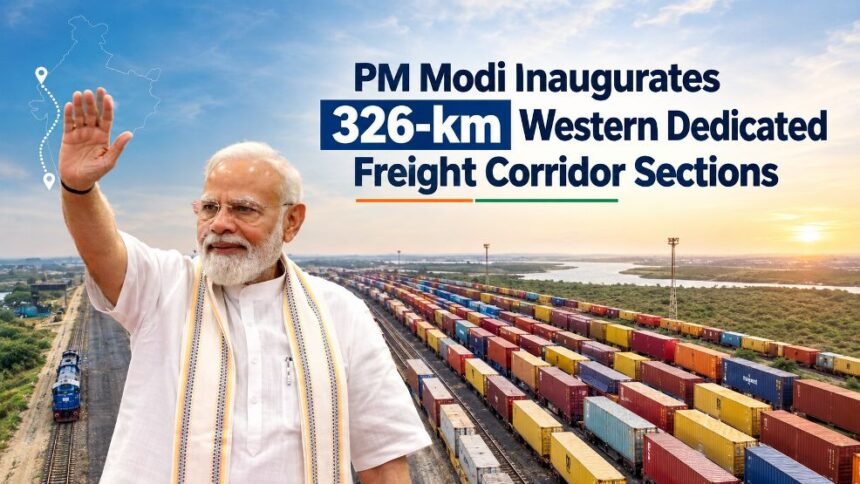
Prime Minister Narendra Modi on Tuesday dedicated three major sections of the Western Dedicated Freight Corridor (WDFC) to the nation, marking the completion of India’s 2,843-km Dedicated Freight Corridor (DFC) network.
- India’s Dedicated Freight Corridor Network Now Fully Operational
- New Freight Train Services Flagged Off
- How the Dedicated Freight Corridor Will Help Indian Railways
- DFC Connects Industrial Centres With Western Ports
- Indian Railways Expands Freight Logistics Infrastructure
- New Dedicated Freight Corridor Also Proposed
- Indian Railways Freight Loading Reaches 1,670 Million Tonnes
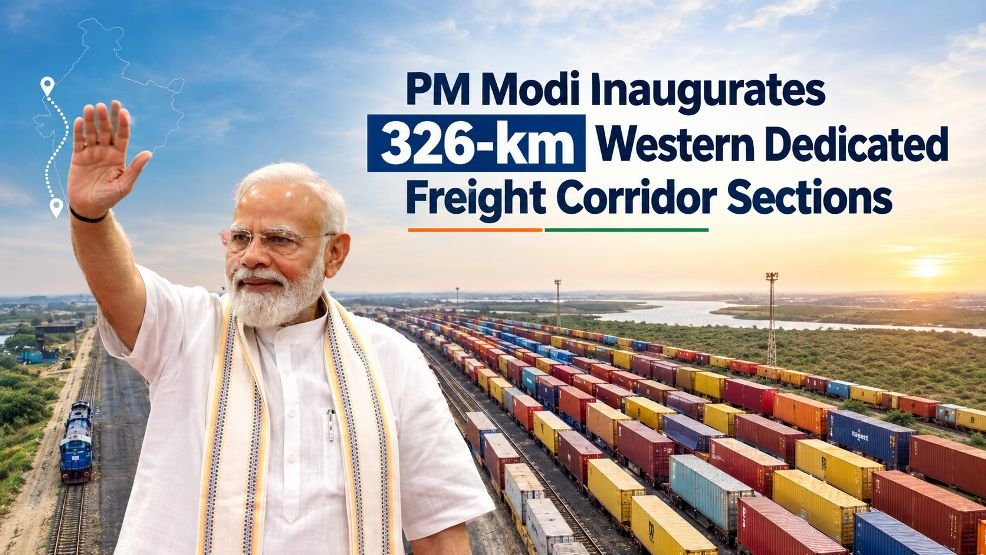
The three newly commissioned sections cover 326 route kilometres and were developed at a combined cost of more than ₹20,700 crore. The sections are New Sanand (North)-New Makarpura, New Umbergaon-New Saphale and New Saphale-New JNPT.
With the new sections becoming operational, the WDFC now provides a continuous connection between Dadri in Uttar Pradesh and Jawaharlal Nehru Port in Maharashtra, while the Eastern Dedicated Freight Corridor (EDFC) connects Ludhiana with Sonnagar.
India’s Dedicated Freight Corridor Network Now Fully Operational
The DFC network consists of two major freight corridors.
- Eastern Dedicated Freight Corridor: 1,337 km from Ludhiana to Sonnagar
- Western Dedicated Freight Corridor: 1,506 km from Dadri to JNPT
- Total DFC network: 2,843 km
The completion of the final WDFC sections marks a major milestone for India’s freight and logistics infrastructure.
The direct connection with Jawaharlal Nehru Port Authority (JNPA) is expected to speed up the movement of export-import cargo between industrial centres and ports. It is also expected to reduce logistics costs, improve multimodal connectivity and ease congestion on Mumbai’s railway network.
New Freight Train Services Flagged Off
During the programme, PM Modi also flagged off freight train services from New Sanand (North), New Makarpura, New Umbergaon and New JNPT in Mumbai.
The DFC network is designed specifically for freight movement, allowing longer and heavier trains to operate more efficiently. The network also supports double-stack container operations, helping increase the amount of cargo that can be transported in a single train.
The DFC network was already handling an average of around 443 freight trains every day, according to reports ahead of the completion of the final sections.
How the Dedicated Freight Corridor Will Help Indian Railways
The dedicated freight infrastructure is expected to have a wider impact on India’s transportation and logistics system.
By shifting a significant portion of freight traffic onto dedicated corridors, capacity can be freed up on conventional railway routes. This can allow Indian Railways to operate more passenger and freight services on its existing network.
The dedicated corridors are also expected to:
- Reduce freight transit times
- Improve reliability of cargo movement
- Lower logistics costs
- Reduce congestion on busy railway routes
- Improve connectivity between industrial hubs and ports
- Support faster EXIM cargo movement
- Strengthen multimodal logistics infrastructure
The ability to operate double-stack container trains and trains with higher axle loads further improves the freight-carrying capacity of the network.
DFC Connects Industrial Centres With Western Ports
The Western Dedicated Freight Corridor is particularly important for connecting manufacturing and industrial centres in northern and western India with major ports.
The completed route provides a direct freight connection towards JNPT near Mumbai, improving access to international trade routes.
The government expects the improved rail connectivity to make the movement of goods between production centres and ports faster and more efficient.
Indian Railways Expands Freight Logistics Infrastructure
The Dedicated Freight Corridor is part of a broader strategy by Indian Railways to increase its share of the country’s freight transportation market.
Several initiatives have been introduced to improve freight handling, strengthen regional connectivity and develop better first- and last-mile logistics solutions.
Development of Modern Freight Terminals
Indian Railways is promoting modern freight terminals under the Gati Shakti Multi-Modal Cargo Terminal (GCT) policy.
The strategy includes developing new rail freight terminals as well as upgrading and expanding infrastructure at railway-owned goods sheds.
The objective is to make cargo handling faster and integrate rail freight more effectively with other modes of transportation.
Private Investment in Wagons
Indian Railways has also introduced schemes to encourage private-sector investment in freight wagons.
Specialised wagons have been developed for commodities such as cement, petroleum products, steel and fly ash, allowing freight transportation to be tailored to the requirements of different industries.
Joint Parcel Product-Rapid Cargo Service
The Joint Parcel Product-Rapid Cargo Service (JPP-RCS) scheme aims to provide customised logistics solutions for customers, including door-to-door parcel delivery.
The system also uses a Virtual Aggregation Platform (VAP) to facilitate online booking of parcel space through aggregators and India Post.
CONCOR Expands Door-to-Door Logistics
Container Corporation of India (CONCOR), a PSU under the Ministry of Railways, is also using JPP-RCS for door-to-door parcel services on routes including Delhi-Kolkata and Mumbai-Kolkata.
CONCOR is also running a pilot project at Sonic Goods Shed to provide door-to-door logistics services.
New Dedicated Freight Corridor Also Proposed
The government is looking beyond the existing Eastern and Western DFC network.
The Union Budget 2026 announced a proposed new Dedicated Freight Corridor connecting Dankuni in the east with Surat in the west. Work on preparing or updating the Detailed Project Report (DPR) for the proposed corridor has already begun.
The proposed expansion could further strengthen India’s freight network by connecting additional industrial regions and improving east-west cargo movement.
Indian Railways Freight Loading Reaches 1,670 Million Tonnes
The expansion of dedicated freight infrastructure comes as Indian Railways continues to increase its freight transportation capacity.
According to the figures provided in the source material, railway freight loading reached 1,670 million tonnes in 2025-26, reinforcing Indian Railways’ position as one of the world’s largest rail freight systems.
The expansion of DFC infrastructure, modern freight terminals, specialised wagons and improved last-mile logistics is expected to play an important role in supporting further growth in India’s freight sector.