

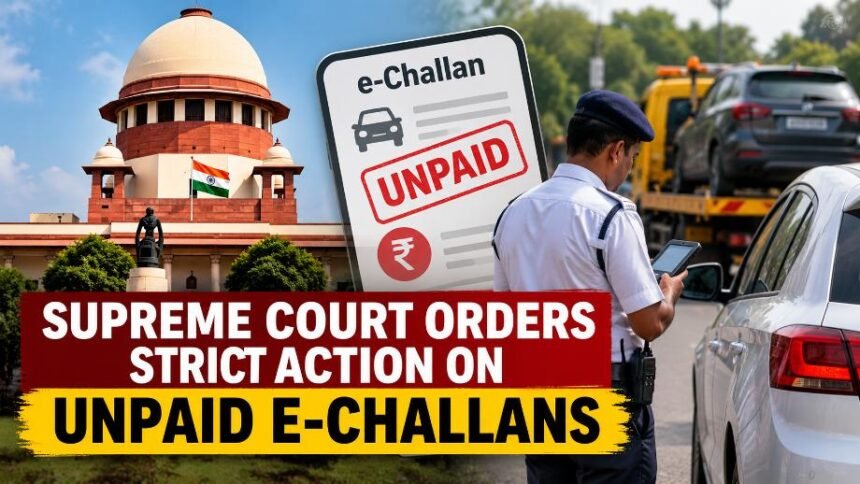
Vehicle owners with long-pending traffic challans may now face stricter enforcement. The Supreme Court has directed states and Union Territories to take stronger measures to recover unpaid e-challans, including steps to impound vehicles found with unpaid challans during random checks.
The directions were issued on September 28 in the ongoing S. Rajaseekaran vs Union of India case, which has been before the Supreme Court since 2012. The court stressed that issuing e-challans alone is not enough and authorities must also ensure effective recovery of the penalties.
Vehicles With Unpaid Challans May Be Impounded
The Supreme Court has directed authorities to conduct random checks of vehicles. If a vehicle is found with an e-challan that has not been honoured, authorities have been directed to take necessary steps for its impounding.
This does not mean that every vehicle with a pending challan will automatically be seized without a check. The direction specifically links the impounding action to enforcement during vehicle checks.
RC Services Can Be Frozen
The Court has also directed authorities to freeze online services for vehicles with unpaid traffic fines.
These restrictions can include:
- Renewal of the Registration Certificate (RC)
- Issuance of a duplicate RC
- Updating the registered owner’s address
- Issuance of a fitness certificate
The vehicle can also be blacklisted on the Parivahan Portal, preventing its sale or transfer of ownership until the outstanding dues are cleared.
PUC Certificate Could Also Be Blocked
The directions extend to pollution certification as well. The Court has said that PUC centres should not issue certificates for vehicles where the relevant traffic fines remain unpaid.
This could create an additional compliance hurdle for vehicle owners who have allowed old challans to remain unresolved.
Action Against Repeat Traffic Violators
The Supreme Court has also directed action concerning driving licences in cases involving multiple violations.
The directions include withholding renewal of the driving licence and taking steps to suspend an existing licence where applicable. This should not be interpreted as an automatic suspension of every driver’s licence merely because a single challan remains unpaid.
More Than ₹49,000 Crore Linked to E-Challans
During the proceedings, the Court was informed that around ₹49,194.05 crore was involved in recoverable amounts relating to e-challans issued across states and Union Territories.
Of this amount, approximately ₹26,175.05 crore had been recovered, leaving around ₹23,019 crore yet to be recovered based on the figures presented to the Court.
The figures underline the scale of the challenge facing authorities in converting electronically issued traffic penalties into actual collections.
Court Pushes for Stronger Digital Enforcement
The Supreme Court has also called for stronger electronic enforcement of traffic rules. The directions include the use of AI-enabled systems to detect specified traffic violations and better integration between platforms such as VAHAN-4, SARATHI, e-Challan, e-DAR and iRAD.
The Ministry of Road Transport and Highways has also been directed to establish a public dashboard showing electronic enforcement data, with the information to be updated at least once a month.
What Vehicle Owners Should Do
The latest directions make it increasingly important for vehicle owners to check whether any traffic challans remain pending against their vehicles.
An unpaid challan can potentially lead to restrictions on vehicle-related services, while enforcement action may follow when authorities identify the outstanding violation during checks.
Vehicle owners should verify their challan status through official government services and clear any legitimate outstanding penalties.
Want to read more news? Check out Nation Newz’s latest news updates for breaking stories and important developments from India and around the world.