

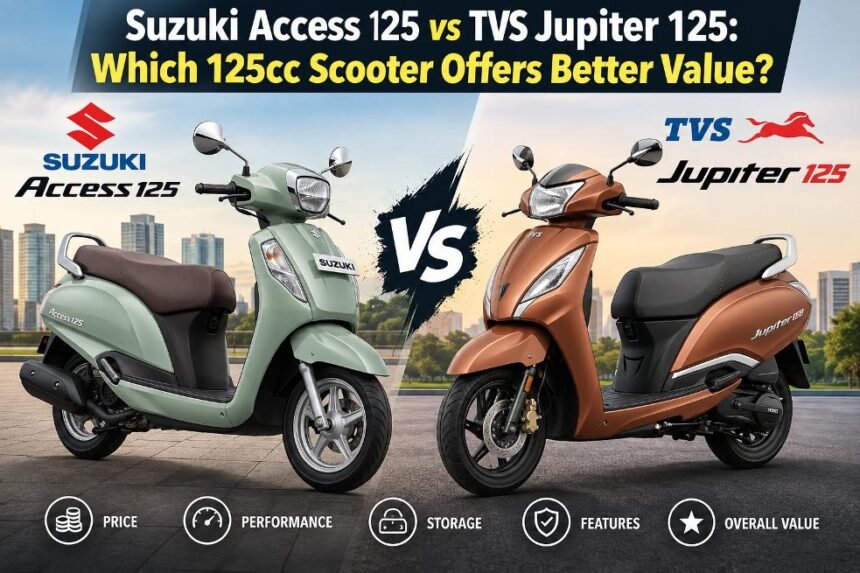
Suzuki Access 125 vs TVS Jupiter 125: If you are planning to buy a new 125cc petrol scooter, the Suzuki Access 125 and TVS Jupiter 125 are two models worth considering. Both scooters have established themselves in India’s two-wheeler market and are priced within a similar range.
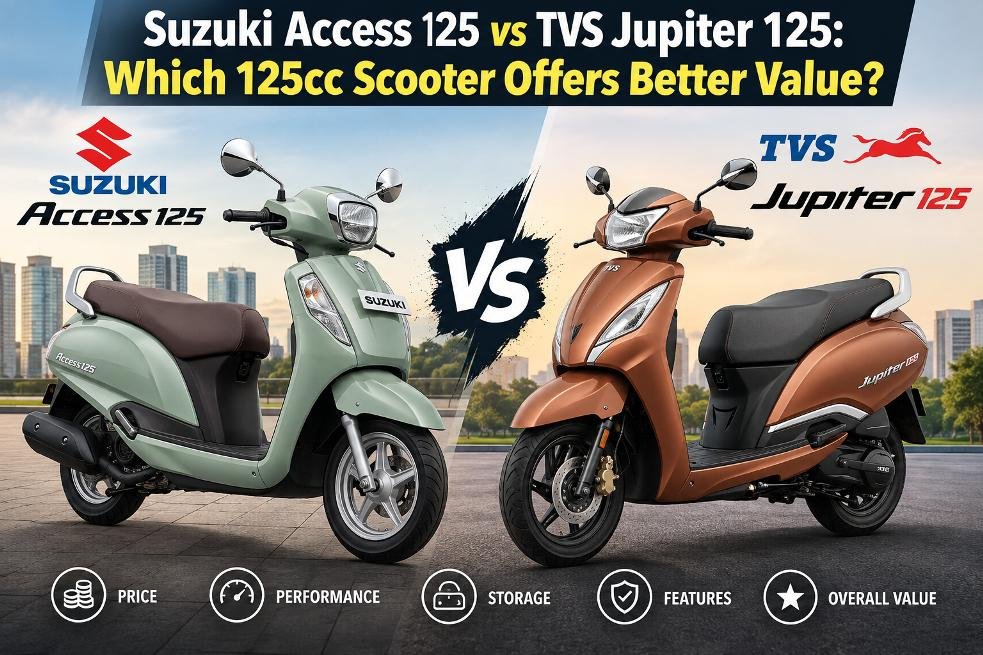
However, their similarities largely end at the price point. The two scooters differ in engine characteristics, storage capacity, braking hardware and connected technology. Here’s a detailed comparison to help you decide which one suits your needs better.
Suzuki Access 125 vs TVS Jupiter 125
Key specifications features and price (Delhi Central) compared
| Specification | Suzuki Access 125 Technology & Performance | TVS Jupiter 125 Practicality & Storage |
|---|---|---|
| Starting Price | ₹82,185 | ₹81,700 Lower Price |
| Engine | 124cc | 124.8cc |
| Power | 6.2 kW / 8.3 hp | 6.0 kW |
| Torque | 10.2 Nm @ 5,000 rpm | 10.5 Nm @ 4,500 rpm Higher Torque |
| Under-Seat Storage | 24.4 litres | 33 litres Winner |
| Front Storage | Available | 2-litre glove box |
| Front Disc Brake | Selected variants | 220mm |
| ABS | Available on select variants | Not available |
| Display | Up to 4.2-inch Colour TFT | Colour TFT |
| Bluetooth | Yes | Yes |
| Navigation | Connected features | Yes |
| Voice Assist | Ride Connect features | Yes |
Suzuki Access 125 vs TVS Jupiter 125: Variant-Wise Price
The Suzuki Access 125 is available in six variants, with prices ranging from the standard drum-brake version to higher-end Ride Connect TFT ABS trims.
| Suzuki Access 125 Variant | Ex-Showroom Price (Delhi Central) |
|---|---|
| Standard Edition Drum | ₹82,185 |
| Special Edition Disc | ₹88,627 |
| Ride Connect Disc + Alloy | ₹90,727 |
| Ride Connect TFT | ₹93,877 |
| Ride Connect ABS | ₹97,030 |
| Ride Connect TFT ABS | ₹1,02,279 |
The TVS Jupiter 125 starts slightly lower, with four main variants:
| TVS Jupiter 125 Variant | Ex-Showroom Price (Delhi Central) |
|---|---|
| Drum Alloy | ₹81,700 |
| Disc | ₹86,110 |
| DT ZX | ₹88,950 |
| SmartXonnect | ₹89,935 |
On pricing, the Jupiter 125 has a lower entry price, while the Access 125 offers a wider range of higher-spec variants.
Engine and Performance
The Suzuki Access 125 uses a 124cc, single-cylinder, air-cooled engine producing 6.2kW, or around 8.3hp, and 10.2Nm of torque. Peak torque arrives at 5,000rpm.
The TVS Jupiter 125 gets a slightly larger 124.8cc, single-cylinder, air-cooled engine. It produces 6.0kW of power and 10.5Nm of torque, with maximum torque available at a lower 4,500rpm.
This gives each scooter a slightly different character. The Access has a small advantage in peak power, while the Jupiter produces marginally more torque and delivers it at lower engine speed. For everyday urban riding, that lower-rpm torque delivery can be useful during frequent stop-and-go traffic.
TVS Jupiter 125 Has the Storage Advantage
Storage is one area where the Jupiter 125 has a clear advantage.
The TVS scooter offers 33 litres of under-seat storage, along with a 2-litre front glove box. This makes it particularly practical for riders who regularly carry bags, groceries or other everyday items.
The Suzuki Access 125 provides 24.4 litres of under-seat storage. While this is sufficient for daily use, it falls significantly short of the Jupiter’s capacity.
For buyers who consider practicality and carrying space a priority, the Jupiter 125 therefore gets the edge.
Seat and Dimensions
The TVS Jupiter 125 has a 790mm-long seat, a 1,275mm wheelbase and 163mm of ground clearance.
While dimensions can provide a useful reference, seat comfort cannot be judged entirely from numbers. Rider height, riding position and pillion comfort also play an important role. Buyers should ideally sit on and ride both scooters before making a final decision.
Braking and Safety
The Jupiter 125’s disc variant gets a 220mm front disc brake paired with a 130mm rear drum brake. TVS also offers its Synchronised Braking Technology on the scooter.
The Access 125 offers a front disc setup on selected variants, while the higher Ride Connect ABS and Ride Connect TFT ABS versions add ABS.
Therefore, buyers who place greater importance on braking technology should pay close attention to the specific variant rather than comparing only the base prices.
Features and Connected Technology
The Access 125 gets increasingly feature-rich as you move up the variant range. Higher versions offer a 4.2-inch colour TFT display, Bluetooth connectivity and Suzuki Ride Connect features.
The Jupiter 125 is also equipped with connected technology in its top SmartXonnect variant. It offers features such as a colour TFT display, Bluetooth connectivity, navigation and voice assistance.
Both scooters therefore provide modern connected features, although the top-end Access 125 stands out by combining its TFT setup with ABS.
Suzuki Access 125 vs TVS Jupiter 125: Which One Should You Buy?
The answer depends largely on what you expect from your scooter.
Choose the TVS Jupiter 125 if storage and practicality are your biggest priorities. Its 33-litre under-seat storage is substantially larger than the Access 125’s 24.4-litre capacity, while its lower-rpm torque delivery can also suit city riding.
Choose the Suzuki Access 125 if you want slightly higher peak power and a broader selection of technology-focused variants. Its higher trims offer features such as a 4.2-inch TFT display, Bluetooth connectivity and ABS.
For primarily urban use, both scooters make a strong case. The Jupiter 125 focuses more on practicality and usable torque, while the Access 125 offers slightly more peak power and a technology-rich upper variant lineup.