

Belgian-American physicist Francis Halzen has won the 2026 Nobel Prize in Physics for his decisive contributions to the IceCube Neutrino Observatory and the discovery of high-energy neutrinos originating from astrophysical sources.
The Royal Swedish Academy of Sciences recognized Halzen’s pioneering work on detecting neutrinos, extremely elusive subatomic particles that can travel through matter with very little interaction.
Why Francis Halzen Won the Nobel Prize
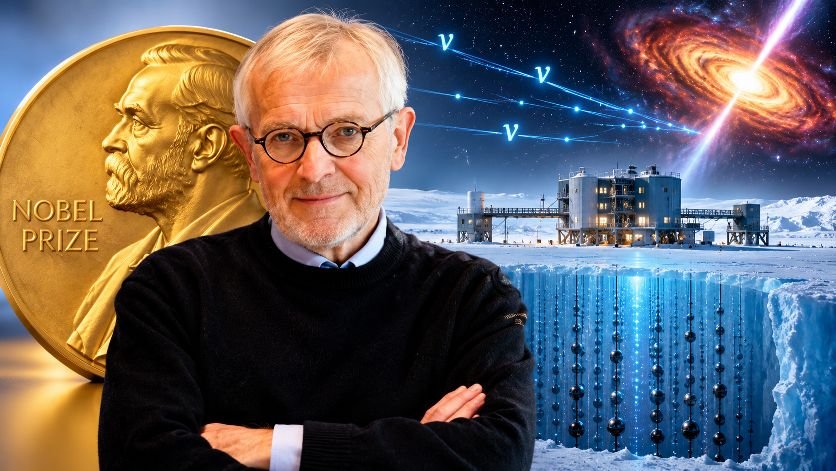
Halzen played a central role in developing the IceCube Neutrino Observatory at the South Pole. The giant detector uses about a cubic kilometre of Antarctic ice equipped with light sensors to detect rare interactions involving neutrinos.
Neutrinos can travel enormous distances across the universe, carrying information about some of the most powerful cosmic events. Detecting high-energy neutrinos has therefore opened a new way for scientists to study the universe.
What Is IceCube?
IceCube is one of the world’s largest neutrino detectors. Buried deep beneath the Antarctic ice, its sensors look for tiny flashes of light produced when neutrinos interact with matter.
The observations can help scientists investigate energetic phenomena in space, including powerful cosmic events that cannot always be studied using ordinary light.
Halzen’s work has helped establish neutrino astronomy as a new way of exploring the universe.
The 2026 Nobel Prize in Physics will be formally presented in Stockholm in December. The prize carries an award of 12 million Swedish kronor.