

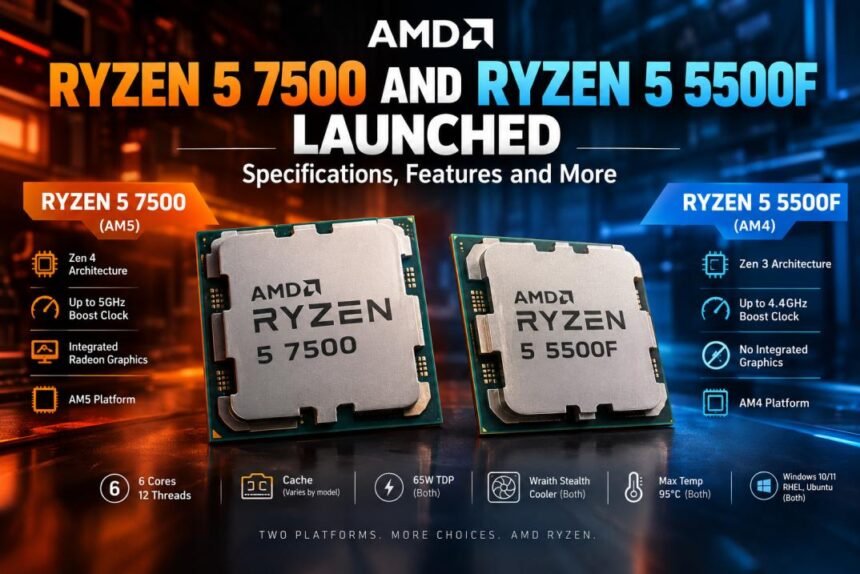
AMD has added two new processors to its Ryzen 5 desktop portfolio, giving PC builders new choices across both its current AM5 ecosystem and the older AM4 platform. The newly announced Ryzen 5 7500 is aimed at AM5 systems and comes with integrated Radeon graphics, while the Ryzen 5 5500F targets budget-conscious users who want to continue using AM4 hardware.
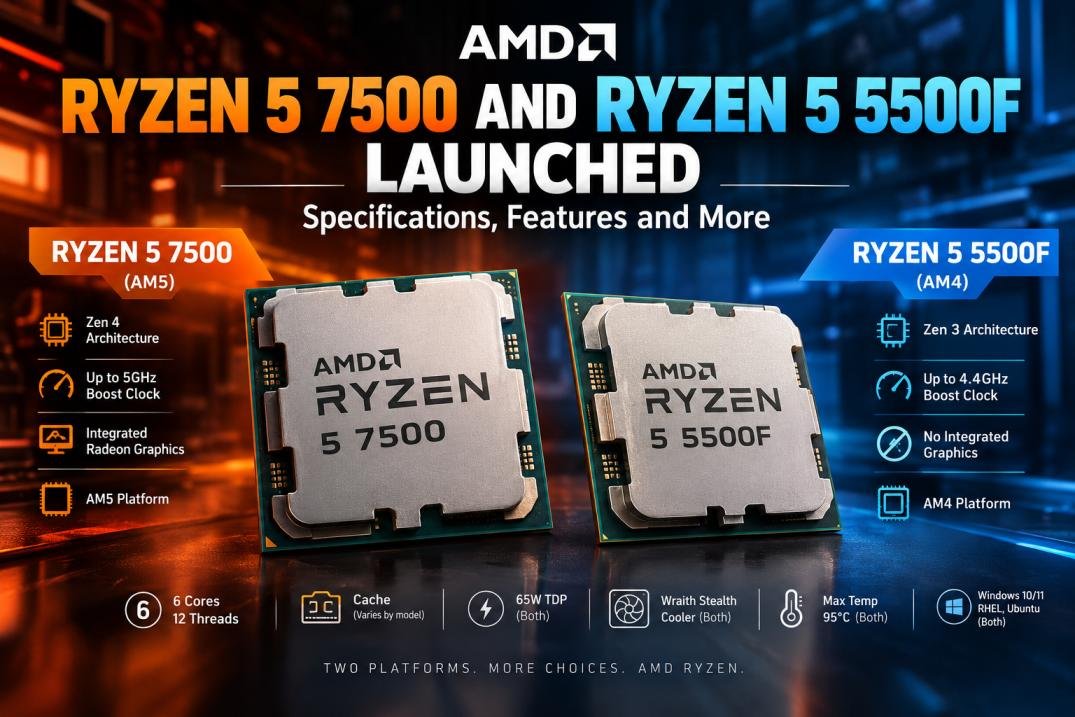
The company announced the two processors on Friday. While the Ryzen 5 7500 brings AMD’s Zen 4 architecture and a boost frequency of up to 5GHz, the Ryzen 5 5500F uses the older Zen 3 architecture and reaches a maximum clock speed of 4.4GHz.
AMD Ryzen 5 7500: Key Details
The Ryzen 5 7500 is a six-core desktop CPU with SMT, allowing it to handle 12 threads simultaneously. Its standard operating frequency is 3.7GHz, while the boost clock can climb to 5GHz.
AMD has equipped the chip with 6MB of L2 cache and 32MB of L3 cache. It carries a 65W default TDP and includes integrated Radeon graphics, meaning a separate graphics card is not necessarily required for basic display output.
The processor is based on AMD’s Zen 4 architecture. Its CPU cores are produced using TSMC’s 5nm FinFET technology, while the I/O die is manufactured on a 6nm FinFET process. The CPU compute die measures 71 square millimetres.
As an AM5 processor, the Ryzen 5 7500 works with a broad selection of AMD chipsets, including A620, B650, B650E, X670, X670E, B840, B850, X870 and X870E.
AMD Ryzen 5 5500F: Key Details
For users who are still building PCs around AM4, AMD has introduced the Ryzen 5 5500F as a lower-cost alternative. The processor is built on the company’s Zen 3 architecture and also features six cores and 12 threads.
The chip operates at a 3GHz base frequency and can boost to 4.4GHz. It has 3MB of L2 cache and 16MB of L3 cache, with the processor’s default TDP set at 65W.
The Ryzen 5 5500F uses a 7nm FinFET manufacturing process from TSMC for its CPU cores. Its compute die measures 74 square millimetres.
The processor uses the AM4 socket and is compatible with several older-generation AMD chipsets, including X570, X470, X370, B550, B450, B350 and A520.
Ryzen 5 7500 vs Ryzen 5 5500F
| Specification | AMD Ryzen 5 7500 | AMD Ryzen 5 5500F |
|---|---|---|
| Architecture | Zen 4 | Zen 3 |
| Platform | AM5 | AM4 |
| CPU Cores | 6 | 6 |
| Threads | 12 | 12 |
| Base Clock | 3.7GHz | 3GHz |
| Boost Clock | Up to 5GHz | Up to 4.4GHz |
| L2 Cache | 6MB | 3MB |
| L3 Cache | 32MB | 16MB |
| Integrated Graphics | Radeon Graphics | No integrated graphics |
| Default TDP | 65W | 65W |
| CPU Process | TSMC 5nm FinFET | TSMC 7nm FinFET |
| Compute Die Size | 71mm² | 74mm² |
| Supported Socket | AM5 | AM4 |
| Included Cooler | AMD Wraith Stealth | AMD Wraith Stealth |
| Max Operating Temperature | 95°C | 95°C |
| Operating Systems | Windows 10/11 64-bit, RHEL, Ubuntu | Windows 10/11 64-bit, RHEL, Ubuntu |
The Ryzen 5 7500 is the more modern processor, with Zen 4 architecture, higher clock speeds, more cache and integrated Radeon Graphics. The Ryzen 5 5500F is aimed at users who want an affordable AM4-based upgrade.
Cooling and Software Support
Both processors come with AMD’s Wraith Stealth cooler and have a maximum operating temperature of 95 degrees Celsius.
The Ryzen 5 7500 and Ryzen 5 5500F support 64-bit Windows 10 and Windows 11, along with Red Hat Enterprise Linux (RHEL) and Ubuntu.
With these launches, AMD continues to support two segments of its desktop CPU ecosystem: the Ryzen 5 7500 adds another Zen 4 option for newer AM5 builds, while the Ryzen 5 5500F provides an additional upgrade path for users who remain on the AM4 platform.