
China has offered to take a leading role in building an AI open-source community for BRICS countries, as Beijing seeks to promote wider access to artificial intelligence technology and strengthen its influence in the global AI ecosystem.
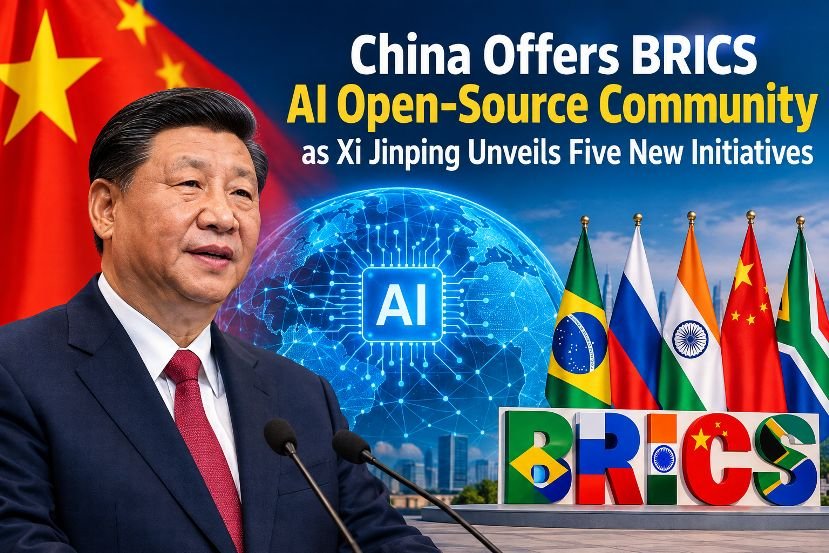
The proposal was announced by Chinese President Xi Jinping during the closing session of the 18th BRICS Summit on Sunday. Xi outlined five initiatives aimed at expanding cooperation among BRICS nations in artificial intelligence, trade, digital industries, smart manufacturing and technological talent development.
Among the proposals, China’s plan for a BRICS AI open-source community has attracted particular attention. Beijing says the initiative would encourage cooperation in the development and use of large language models (LLMs), while also creating opportunities for technical training and knowledge sharing.
China Proposes BRICS AI Open-Source Community
Xi Jinping said China is prepared to lead the establishment of a BRICS AI open-source community. The initiative would focus on cooperation in the development and deployment of large language models, alongside specialised seminars and training programmes.
The broader objective is to build a more open AI ecosystem in which BRICS countries can share technology, expertise and resources.
The proposal also fits into China’s wider push to present itself as an advocate of more accessible AI technology. Over the past two years, Chinese AI models such as DeepSeek, Qwen and Kimi have gained international attention, with their technologies being made available for use and development in different markets.
Several developing countries are also using Chinese AI models as a foundation for systems adapted to their own languages and local requirements.
AI Cooperation Could Expand Across BRICS
China’s proposal could potentially give these existing technology links a more formal framework within the BRICS grouping.
The New Delhi Joint Declaration, issued a day earlier, did not specifically mention the Chinese proposal for a BRICS AI open-source community. However, the declaration did highlight the importance of broader access to AI resources, as well as the need for AI to be safe, trustworthy and inclusive.
India’s position on deeper cooperation with Chinese technology companies remains significant. While New Delhi supports greater access to advanced technology, its approach toward Chinese technology firms has been cautious for diplomatic and strategic reasons.
The AI proposal therefore has the potential to become an important area of discussion within future BRICS technology cooperation.
Xi Jinping Announces Five BRICS Initiatives
AI was only one part of Xi Jinping’s broader five-point proposal for BRICS cooperation.
Under a proposed Trade and Investment Facilitation Initiative, China suggested creating a BRICS special economic zone partnership. The plan would involve manufacturing zones operating under coordinated policies, with the aim of creating new opportunities for open economic development among member countries.
The second major proposal focuses on the digital industry. China wants BRICS countries to cooperate on digital ecosystem cloud platforms, digital skills training, technology exchanges and stronger links between industries.
A third initiative targets smart manufacturing. China has offered to help other BRICS members develop smart factories, establish relevant standards and accelerate the transformation of traditional manufacturing through new technologies.
The fifth proposal focuses on science and technology talent development. China has suggested creating a BRICS Engineers Training Alliance to support joint development of engineering talent and promote mutual recognition of professional qualification standards.
China’s Growing Technology Diplomacy
Taken together, the five initiatives reflect China’s broader effort to deepen technological and economic cooperation with developing countries.
The AI open-source proposal is particularly significant because access to advanced AI models has become an increasingly important part of the global technology race. While the United States and Europe have placed restrictions around some advanced AI technologies and semiconductor exports, China has increasingly promoted the international use of several of its AI models.
For Beijing, greater cooperation with BRICS countries could help expand the global footprint of Chinese technology while giving developing economies greater access to AI tools, digital infrastructure and technical expertise.
The success of these proposals will depend on how individual BRICS members, including India, respond and how much practical cooperation emerges from the initiatives in the coming months.