

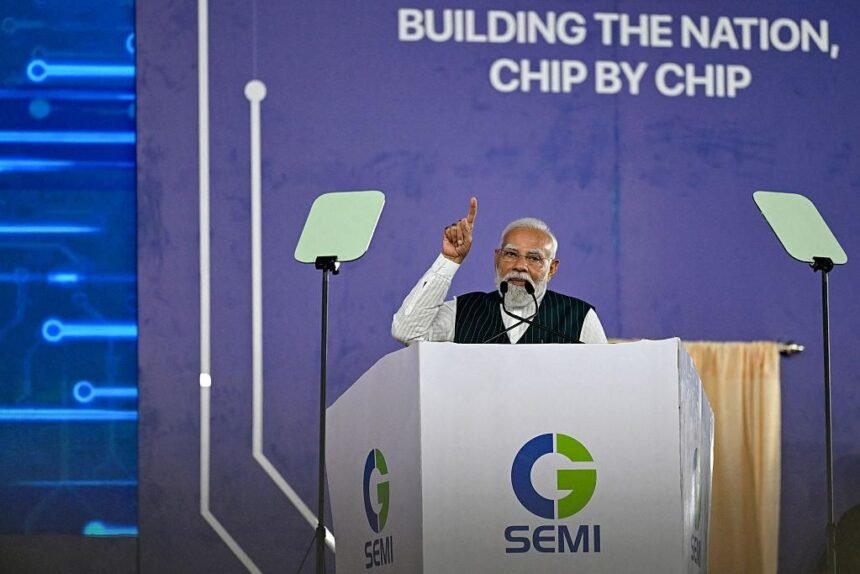
Prime Minister Narendra Modi will meet global semiconductor industry leaders in New Delhi on September 16, a day before inaugurating SEMICON India 2026 at Yashobhoomi in Dwarka.

The meeting will bring together executives from the global chip industry as India looks to attract investment in semiconductor manufacturing, packaging and other parts of the electronics supply chain.
PM Modi to meet global chip CEOs
The roundtable with semiconductor CEOs will take place on September 16, according to Amitesh Kumar Sinha, Additional Secretary at the Ministry of Electronics and Information Technology (MeitY) and CEO of the India Semiconductor Mission.
Modi will inaugurate SEMICON India 2026 on September 17. He also held a similar meeting with semiconductor executives during the 2025 edition.
The government is using the event to showcase India’s growing semiconductor ecosystem and attract companies looking to establish manufacturing and packaging facilities in the country.
India targets a $200 billion semiconductor market
India’s semiconductor industry is expected to grow significantly in the coming years.
According to MeitY, global semiconductor demand could rise from around $1 trillion to $2 trillion, while India’s demand is expected to increase from approximately $100 billion to $200 billion.
The government has set a target of placing India among the world’s top five semiconductor ecosystems by 2029.
SEMICON India 2026 to be bigger
The 2026 edition, themed “Silicon to Systems: Building the Ecosystem,” is being organised by the India Semiconductor Mission, MeitY and SEMI.
The event is expected to feature:
- More than 500 exhibitors
- Over 150 speakers
- Delegations from 40+ countries
- Six country pavilions
- 10 state government pavilions
- Around 15,000 square metres of exhibition space
Major companies expected to participate include ASML, Applied Materials, Teradyne, Infineon, Micron, Tata Electronics, Lam Research, Tokyo Electron, NXP and IBM Research.
India’s semiconductor projects gain momentum
The government says semiconductor manufacturing projects approved under the first phase of its programme are now beginning to become operational.
Three units by Micron, Kaynes and CG Semi in Sanand, Gujarat, have entered commercial production.
Around five or six semiconductor units could be operational by the end of 2026, according to MeitY Secretary S. Krishnan.

One of the major projects expected to begin production is the Tata-Powerchip semiconductor fabrication plant in Dholera, Gujarat. The ₹91,000-crore facility is designed to produce up to 50,000 wafers per month using the 28-nanometre process.
What is Semicon 2.0?
The government is also preparing to launch Semicon 2.0, the second phase of India’s semiconductor programme.
The Union Cabinet approved the programme in July with an outlay of ₹1.275 lakh crore, compared with ₹76,000 crore for the first phase.
Semicon 2.0 will focus on areas including:
- Chip design
- Semiconductor manufacturing
- Equipment and materials
- Advanced packaging
- Research and development
- Silicon photonics and power semiconductors
- Semiconductor talent development
The programme’s timeline has also been extended to 12 years, giving investors more time to develop large and complex semiconductor projects.
India wants to become a global chip hub
India has traditionally relied heavily on imported semiconductors. The government is now trying to build a domestic ecosystem covering everything from chip design and manufacturing to packaging and electronic systems.

The government says it has already provided semiconductor design tools to more than 332 academic institutions and 105 startups, while 24 startups have been approved under the Design Linked Incentive scheme.
With SEMICON India 2026 bringing together global chipmakers, technology companies and Indian businesses, the event is expected to play an important role in India’s push to become a major global semiconductor hub.