

The Jharkhand High Court has sought a detailed response from the Jharkhand Staff Selection Commission (JSSC) over its decision to conduct a re-examination for 2,819 candidates who appeared for the Secondary Acharya recruitment exam.
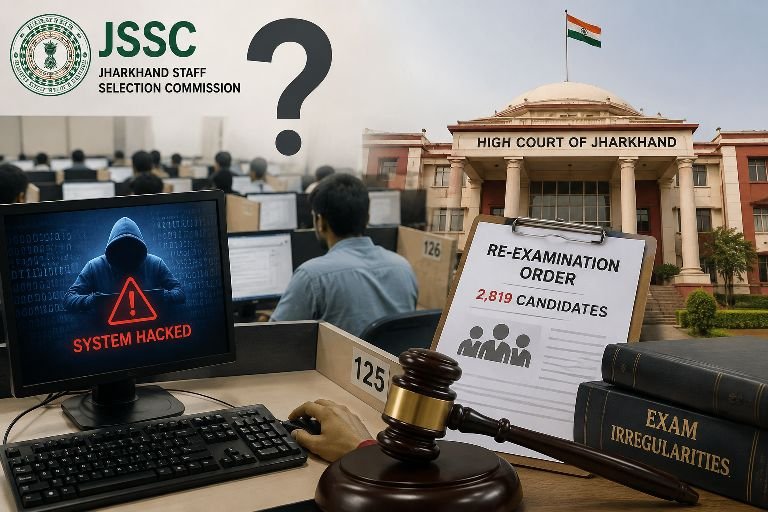
The matter came up for hearing before Justice Deepak Roshan on Monday. The court specifically asked whether it is technically possible for an individual computer system at an examination centre to be externally manipulated or hacked during an online computer-based examination.
The court has directed JSSC to obtain a technical opinion from an expert institution, including BIT Mesra, and submit a detailed response through an affidavit. The next hearing in the case is scheduled for August 29.
Why Is JSSC Conducting a Re-Examination?
The dispute relates to the Secondary Acharya recruitment online examination, in which around 25,000 candidates appeared.
According to JSSC, its monitoring system detected signs of external interference in the computer systems used by 2,819 candidates during the examination. The commission subsequently locked the answer records of these candidates.
JSSC then issued notices to the affected candidates, asking them whether they had any involvement in the alleged interference with their examination systems. The candidates were also asked to submit affidavits explaining their position.
Following this process, the commission issued another notice requiring the 2,819 candidates to appear for a re-examination. Some of the candidates have now challenged the decision before the Jharkhand High Court.
Candidates Question Selective Re-Examination
During the hearing, petitioners Arpana Kumari and others argued that conducting another examination only for a section of candidates was unfair.
Advocates Rupesh Singh and Chanchal Jain, appearing for the petitioners, argued that once the examination had already been conducted, holding a fresh test only for certain candidates could result in unequal treatment.
The petitioners have challenged JSSC’s notice directing the affected candidates to take the examination again.
What Did JSSC Tell the High Court?
Representing JSSC, advocates Sanjay Piparwal and Prince Kumar told the court that the examination was conducted online through a computer-based testing system.
They said special software had been used to monitor the examination systems and detect any external interference or tampering.
According to the commission, the monitoring process identified external influence in the systems assigned to 2,819 candidates. Their answer records were subsequently locked as a precaution.
High Court Questions Possibility of Computer Hacking
A key issue raised by the court was whether a particular computer at an examination centre could actually be targeted and affected from outside during the examination.
The court also questioned why a high-level investigation had not been conducted if there was evidence of external interference or hacking.
JSSC told the court that a high-level investigation could be carried out into the matter.
The court also sought clarification on the basis for conducting a re-examination only for the candidates whose systems were reportedly affected.
JSSC Asked to Submit Technical Opinion
The High Court has now asked the commission to obtain a technical assessment from an expert institution such as BIT Mesra.
JSSC has been directed to submit a detailed response in the form of an affidavit, particularly addressing whether the alleged external interference in individual examination computers was technically possible.
The court is expected to consider the commission’s response at the next hearing on August 29.
What Happens Next?
The case could have significant implications for the affected Secondary Acharya candidates. The High Court’s next hearing is likely to focus on the technical evidence surrounding the alleged computer interference, the basis for identifying the 2,819 systems and whether a selective re-examination is justified.
For now, the re-examination decision remains under judicial scrutiny, with the court seeking clearer technical and procedural answers from JSSC before proceeding further.