
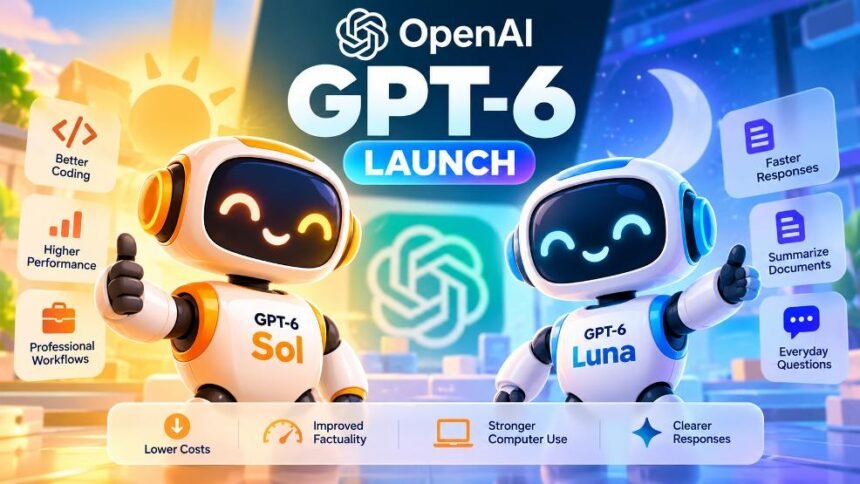
OpenAI has expanded its GPT-6 lineup with the launch of GPT-6 Sol and GPT-6 Luna, two new AI models designed to bring stronger performance to developers and businesses at a lower cost.
The models were released on September 22, 2026, following the earlier launch of GPT-6 Astra. OpenAI says Sol and Luna incorporate several of the improvements introduced with Astra, including advances in coding, professional work, factuality, computer use and alignment.
GPT-6 Sol and Luna: What’s New?
GPT-6 Sol is positioned for more demanding tasks, including coding and complex professional workflows, while GPT-6 Luna is aimed at faster, high-volume tasks such as summarizing documents, extracting information and answering routine questions.
OpenAI says GPT-6 Sol produces about half as many mistakes as GPT-5.6 Sol on its internal factuality evaluation. The company also reports improvements in coding and computer-use performance compared with the previous generation.
The models are also designed to provide clearer and more concise responses, with OpenAI saying the improvements from GPT-6 Astra’s communication style have been incorporated into Sol and Luna.
Also Read: OpenAI Chief Scientist Warns AI Progress Could Outpace Human Control
GPT-6 Sol and Luna Prices Cut
One of the biggest changes with the new models is their API pricing.
According to OpenAI’s API documentation, GPT-6 Sol costs $2 per million input tokens and $10 per million output tokens. GPT-6 Luna costs $0.10 per million input tokens and $0.50 per million output tokens.
OpenAI says the pricing represents a 50% reduction compared with the promotional pricing of the GPT-5.6 Sol and Luna models, helped by improvements in caching and inference efficiency.
Where Are GPT-6 Sol and Luna Available?
The new models are available through OpenAI’s API and have also been introduced to ChatGPT Work and Codex. Availability depends on the user’s plan and workspace configuration.
OpenAI has also said GPT-6 Luna is available to Free and Go users through the desktop app, while broader rollout to ChatGPT is taking place gradually.
What the GPT-6 Launch Means
The launch highlights an important direction in the AI industry: improving not only model capabilities but also the cost of running increasingly capable AI systems.
By offering more capable models at lower API prices, OpenAI is targeting developers and companies that need to run AI applications at scale. GPT-6 Sol and Luna therefore complement the higher-end GPT-6 Astra rather than replacing it.
With multiple AI companies releasing new models in September, the latest GPT-6 launch adds another major development to an increasingly competitive AI market.