

Uttar Pradesh: Forget ordinary trucks. A gigantic 308-wheel ‘Mahabali’ heavy-haul transporter is currently making its way across India with a massive industrial machine that weighs more than 164 tonnes.
- Why Does a 164-Tonne Machine Need 308 Wheels?
- What Exactly Is Being Transported?
- Belgium to Uttar Pradesh: A Long Journey
- Why Does It Move Only 10–20 Km a Day?
- The ₹2 Crore Diesel Bill
- What Happens When the Road Gets in the Way?
- Why Are People Stopping to Watch?
- The Real Challenge Isn’t the Truck—It’s the Road
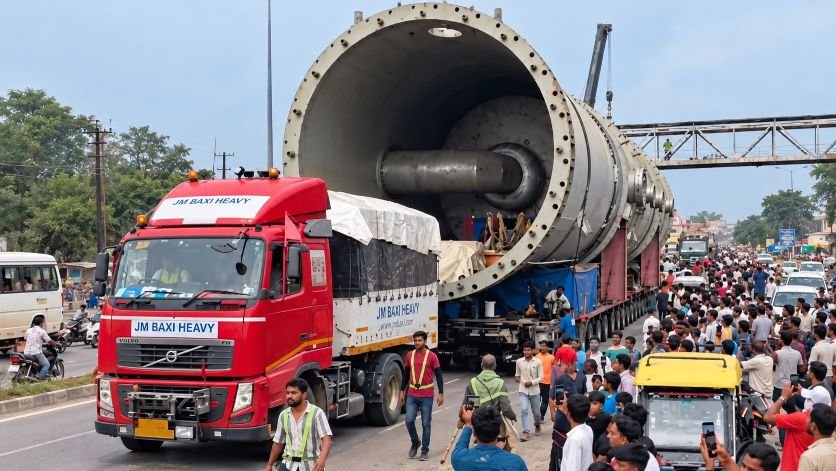
The extraordinary convoy is travelling from Paradip Port in Odisha to Kumbhi in Lakhimpur Kheri, Uttar Pradesh, where the machine will be installed at a biopolymer plant being developed by Balrampur Chini Mills.
And there is a reason this journey is attracting so much attention: the convoy can move only around 10–20 km in a day on difficult stretches, while reports say roughly 200 litres of diesel can be consumed per day.
The Mahabali Truck in Numbers
| Feature | Details |
|---|---|
| Number of wheels/tyres | Around 308 in the reported configuration |
| Machine weight | 164.28 tonnes |
| Machine length | Around 41 metres |
| Loaded vehicle weight | Around 294 tonnes according to the reported transport specification |
| Daily distance | Around 10–20 km on difficult stretches |
| Diesel consumption | Around 200 litres per day reported |
| Reported diesel expenditure | Around ₹2 crore so far |
| Machine | Cyclisation reactor |
| Made in | Belgium |
| India arrival point | Paradip Port, Odisha |
| Final destination | Kumbhi, Lakhimpur Kheri, Uttar Pradesh |
| Project | Biopolymer plant |
| Transporter | Special modular hydraulic heavy-haul trailer |
| Prime movers | Volvo heavy-haul trucks reported in the convoy |
The machine’s reported weight and dimensions come from transport and media reports; the diesel figures are reported operational figures rather than a fixed specification of the transporter.
Why Does a 164-Tonne Machine Need 308 Wheels?
This isn’t simply a gigantic truck with an unusually large number of tyres.
The 308 wheels are part of a modular hydraulic trailer system. Multiple axle lines are connected to distribute the enormous load across a much larger area.
That is important because putting more than 160 tonnes of machinery on a conventional trailer could put excessive stress on individual axles, roads and bridges.
The machine itself cannot simply be dismantled into smaller pieces, so the engineering challenge is to move the entire unit safely to the destination.
What Exactly Is Being Transported?
The star of this massive convoy is a cyclisation reactor.
The reactor was manufactured in Belgium and transported by sea to Paradip Port in Odisha. From there, the difficult road journey began.
Its final destination is Balrampur Chini Mills’ Kumbhi facility in Lakhimpur Kheri, where it is intended for a major biopolymer project.
Belgium to Uttar Pradesh: A Long Journey
The journey began in Belgium in April 2026. After travelling by sea for roughly a month, the equipment reached Paradip.
From the port, the convoy began its road journey through Odisha, Jharkhand, Bihar and Uttar Pradesh.
The route has included places such as:
Paradip → Odisha → Jharkhand → Bihar → Chandauli → Varanasi → Uttar Pradesh → Lakhimpur Kheri
The road journey alone covers roughly 1,000 kilometres on the reported route, although the entire operation is much more complicated because the convoy has to stop and prepare sections of the route along the way.
Why Does It Move Only 10–20 Km a Day?
This is probably the most surprising part of the story.
A normal truck can cover hundreds of kilometres in a day. The Mahabali, however, sometimes manages only 10–20 km.
Every kilometre has to be checked for:
- Bridges and road load limits
- Electricity lines
- Poles and signboards
- Road width
- Sharp turns
- Flyovers and underpasses
- Weak or damaged road sections
- Traffic movement
In some locations, the road itself has had to be prepared before the convoy could continue.
The ₹2 Crore Diesel Bill
Moving such a giant convoy also comes with a huge fuel bill.
Media reports have put the cumulative diesel expenditure at around ₹2 crore, while the driver has reportedly said that the operation consumes roughly 200 litres of diesel per day.
That means this isn’t just an engineering challenge—it is also an enormous logistical operation involving fuel, escort vehicles, engineers, drivers, road crews and traffic management.
What Happens When the Road Gets in the Way?
This is where the journey becomes particularly unusual.
If the convoy encounters a power line, pole, signboard or other obstruction, the relevant authorities have to coordinate with the transport operator before it can be removed, shifted or temporarily switched off.
Bridges and other structures also have to be assessed before the convoy is allowed to pass.
At some points, the transporter has reportedly had to wait while teams prepared the route ahead.
Why Are People Stopping to Watch?
The sheer size of the convoy has turned it into something of a roadside spectacle.
A 41-metre-long machine sitting on a multi-axle transporter is not something people see every day. As the convoy passes through towns and villages, people have been stopping to take photographs and record videos.
The journey has consequently generated significant attention on social media.
The Real Challenge Isn’t the Truck—It’s the Road
The Mahabali’s journey shows just how complicated it can be to move extremely large industrial equipment by road.
The transporter has the wheels and power needed to carry the load. But the bigger challenge is everything around it—the bridges, electricity lines, road width, traffic and infrastructure.
And that explains why a journey of roughly 1,000 kilometres can take months rather than days.
For now, the 308-wheel giant continues its slow journey toward Kumbhi in Lakhimpur Kheri, carrying a machine that travelled from Belgium to India and is now completing the final—and perhaps most difficult—part of its journey by road.