

Nepal is facing the possibility of another major flood after a temporary lake formed near the Nepal-China border following the devastating floods and landslides that have already killed more than 600 people.
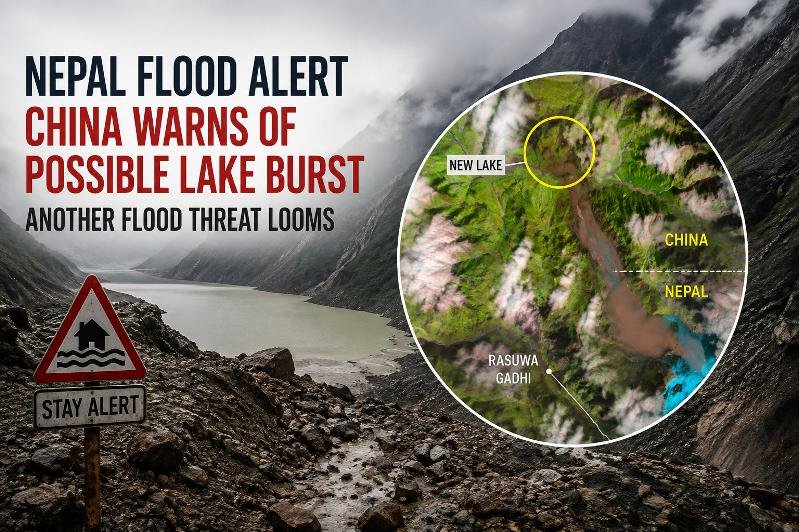
Chinese authorities have issued a fresh warning that the newly formed lake could potentially breach its natural barrier, creating another dangerous flood threat for downstream areas. The warning comes just a day after China and Nepal suspended rescue operations in parts of the region because of concerns over the unstable conditions.
Authorities are closely monitoring the lake as its water level continues to rise and the appearance of the water reportedly changes.
Temporary Lake Near Rasuwa Border Raises Concern
According to reports, Chinese officials have urged Nepal to remain on high alert over the newly formed water body.
The lake reportedly developed after large amounts of debris accumulated in the area following the flash floods. Officials have observed that the colour of the lake water has been becoming darker, which has raised concerns about its stability and the possibility of a sudden breach.
People living in low-lying areas have been advised to remain particularly cautious in case water is released suddenly.
Nepal’s National Disaster Risk Reduction and Management Authority (NDRRMA) has also shared a satellite image of the lake on X, highlighting the developing situation.
Where Has the New Lake Formed?
The temporary lake is reportedly located around 18 kilometres from the Rasuwa Gadhi border crossing and covers approximately 0.11 square kilometres.
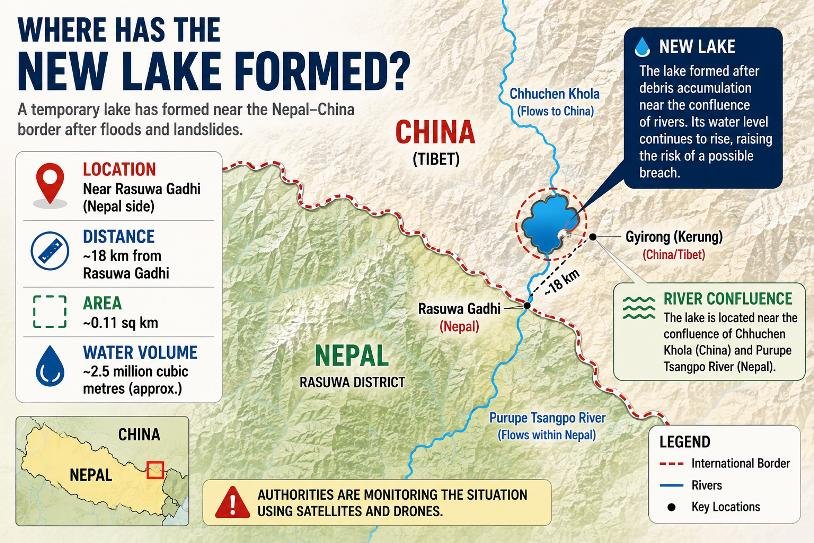
It has formed near the meeting point of the Chhuchen Khola River, which flows toward China, and the Purupe Tsangpo River in Nepal.
According to information from China’s Ministry of Water Resources, the amount of water in the lake has continued to increase.
Reports suggest that approximately 2.5 million cubic metres of water has accumulated in the lake so far, making its stability an important concern for authorities monitoring the area.
Why Could a Lake Burst Cause Another Flood?
A lake formed by debris or other natural barriers can become dangerous if the barrier holding back the water weakens or collapses.
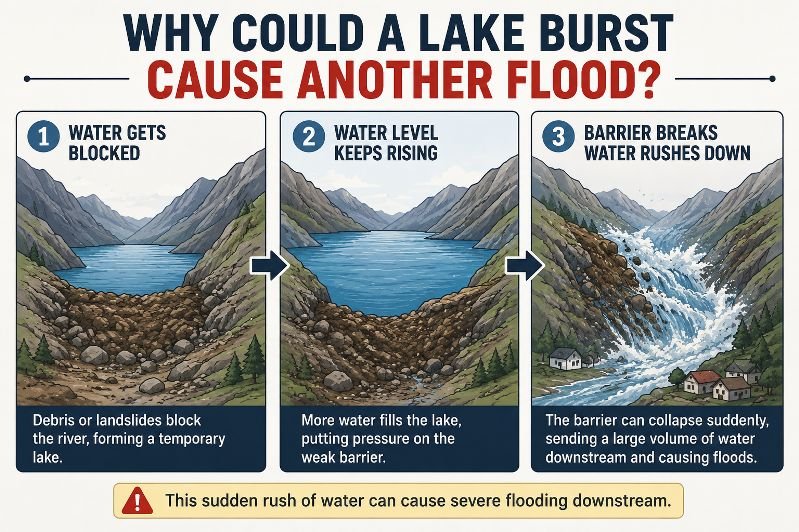
If the temporary barrier gives way suddenly, a large volume of water could rush downstream within a short period. This can potentially increase river levels and threaten communities located along downstream river channels.
Because the lake has formed in a mountainous and disaster-affected region, authorities are closely watching changes in its water level and surrounding terrain.
China Conducts Flood-Risk Assessment
Chinese authorities are reportedly using modelling techniques to estimate what could happen if the lake were to breach.
Initial assessments suggest that the resulting water flow could remain below 500 cubic metres per second. Based on this assessment, the flow may remain largely within the existing river channels rather than causing widespread overflow.
However, authorities continue to monitor the situation because conditions in the region can change rapidly.
Lake Water Has Already Overflowed Into Rivers
China had previously reported on August 28 that water from the lake had begun overflowing and entering the Trishuli River and Lhande Khola River.
Later, Chinese state broadcaster CCTV reported that the immediate risk had been brought under control.
Despite this, monitoring operations have not stopped.
Chinese authorities are using satellite imagery and drones to keep track of the lake and surrounding areas and to identify any changes that could increase the flood risk.
Nepal Remains on Alert After Devastating Floods
The latest warning comes as Nepal is still dealing with the enormous destruction caused by the recent floods and landslides.
More than 600 people have reportedly died, while thousands remain missing or affected by the disaster. Rescue teams have been working in difficult mountainous terrain, where damaged roads, bridges and communication networks have made operations more challenging.
The possibility of another flood has therefore added to concerns among residents and emergency authorities.
For now, officials are continuing to monitor the temporary lake and assess whether changes in its water level or surrounding barrier could create a fresh danger downstream.
Nepal Flood: Key Points
- A temporary lake has formed near the Nepal-China border.
- The lake is around 18 km from Rasuwa Gadhi.
- It covers approximately 0.11 sq km.
- Around 2.5 million cubic metres of water has reportedly accumulated.
- China has warned that the lake could potentially breach.
- Water has reportedly overflowed toward the Trishuli and Lhande Khola rivers.
- China is monitoring the area using satellites and drones.
- Authorities are assessing the potential impact through flood modelling.
- Residents in downstream and low-lying areas have been urged to remain alert.