


The Indian Air Force (IAF) has launched Dronathon-2026, a three-day exercise focused on testing next-generation unmanned systems under realistic operational conditions. The event began on September 14 at the Pokhran Field Firing Range in Jaisalmer, Rajasthan, and will continue until September 16.
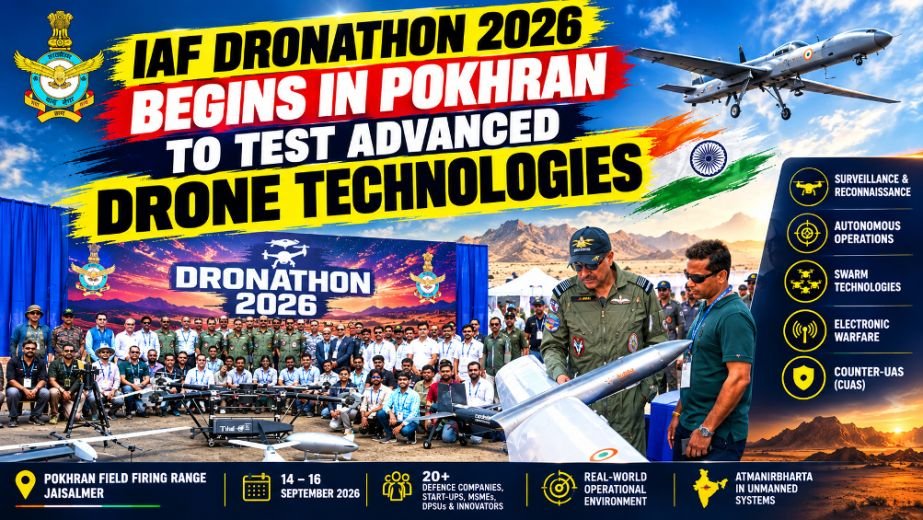
More than 20 defence companies, start-ups, MSMEs, DPSUs and technology innovators are taking part in the initiative, showcasing unmanned technologies designed for a range of military applications.
Air Marshal Ashutosh Dixit Inaugurates Dronathon
Air Marshal Ashutosh Dixit, Vice Chief of the Air Staff, inaugurated the event. Senior representatives from the Ministry of Defence, Headquarters Integrated Defence Staff, the Indian Army and the Border Security Force were also present during the opening ceremony.
The IAF has designed Dronathon as a platform to engage directly with India’s rapidly expanding unmanned-systems industry and assess technologies in demanding operational environments.
Surveillance, Swarms and Electronic Warfare
The demonstrations cover several emerging areas, including:
- Intelligence, surveillance and reconnaissance
- Autonomous unmanned operations
- Swarm technologies
- Electronic warfare
- Counter-Unmanned Aircraft Systems (CUAS)
According to the IAF, unmanned platforms can complement manned aircraft by giving commanders additional operational options. Such systems could improve the reach, persistence, responsiveness and flexibility of air operations.
However, Dronathon-2026 is intended to go beyond conventional technology demonstrations. Participating systems are being assessed for their reliability, effectiveness in contested environments, adaptability and ability to respond to evolving threats.
IAF Releases UAS Roadmap
A major development during the event was the release of the ‘IAF UAS Roadmap’ by the Vice Chief of the Air Staff.
The roadmap is intended to give Indian companies, academic institutions and research organisations greater visibility into the Air Force’s future unmanned-system requirements. This could help developers align their research and product development with the IAF’s long-term capability priorities.
IAF Demonstrates Indigenous ‘Vayu UTtaM’
The IAF also demonstrated ‘Vayu UTtaM’, an indigenously developed multi-mode Unmanned Traffic Management system.
During a live demonstration at Pokhran, the system detected and tracked both military and civilian unmanned aircraft. It is designed to help manage increasingly crowded airspace while supporting the detection and timely mitigation of unauthorised or rogue drones.
Beyond defence applications, the technology could potentially support civil aviation, critical infrastructure protection, airspace safety and public safety.
Focus on Atmanirbharta
Dronathon-2026 also highlights the IAF’s push for Atmanirbharta, or greater self-reliance, in unmanned technologies.
The initiative extends beyond drone platforms themselves and covers the broader ecosystem, including propulsion, sensors, payloads, communications, autonomy, electronic warfare, countermeasures and airspace-management technologies.
The three-day exercise is expected to help the IAF identify technologies with practical operational value while giving India’s unmanned-systems industry an opportunity to test and refine indigenous solutions for future air operations.
Official Source: Press Information Bureau (PIB) – Dronathon-2026 Press Release