

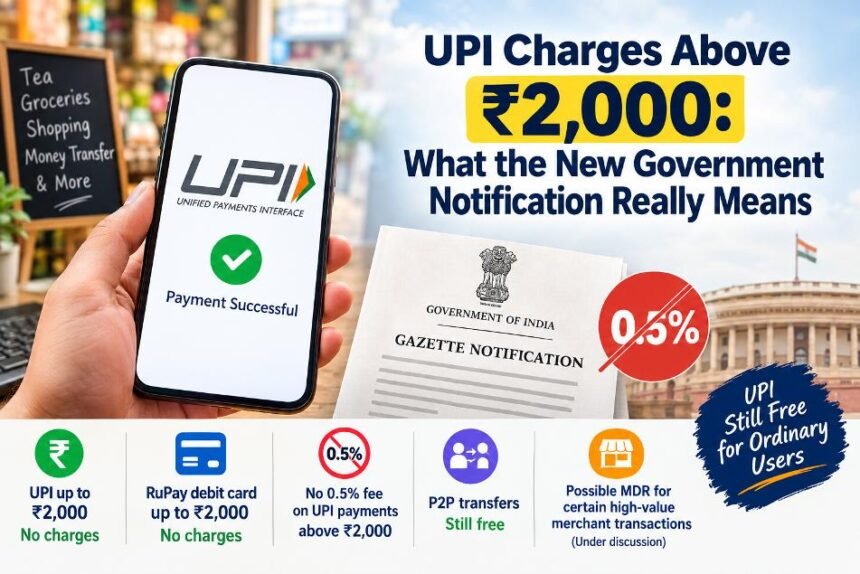
Unified Payments Interface (UPI) has become a part of everyday life in India, from paying for tea and groceries to online shopping and transferring money. However, recent reports about possible UPI charges have created confusion, particularly after the central government issued a new gazette notification on September 14.
- What does the new UPI notification say?
- Why has the ₹2,000 limit triggered controversy?
- Has the 0.5% UPI charge been introduced?
- What has Congress alleged?
- What have the government and BJP said?
- Will P2P UPI transfers be charged?
- Could MDR be introduced above ₹2,000?
- What is the government committee considering?
- What has Finance Minister Nirmala Sitharaman said?
- What does this mean for ordinary UPI users?
- Bottom line
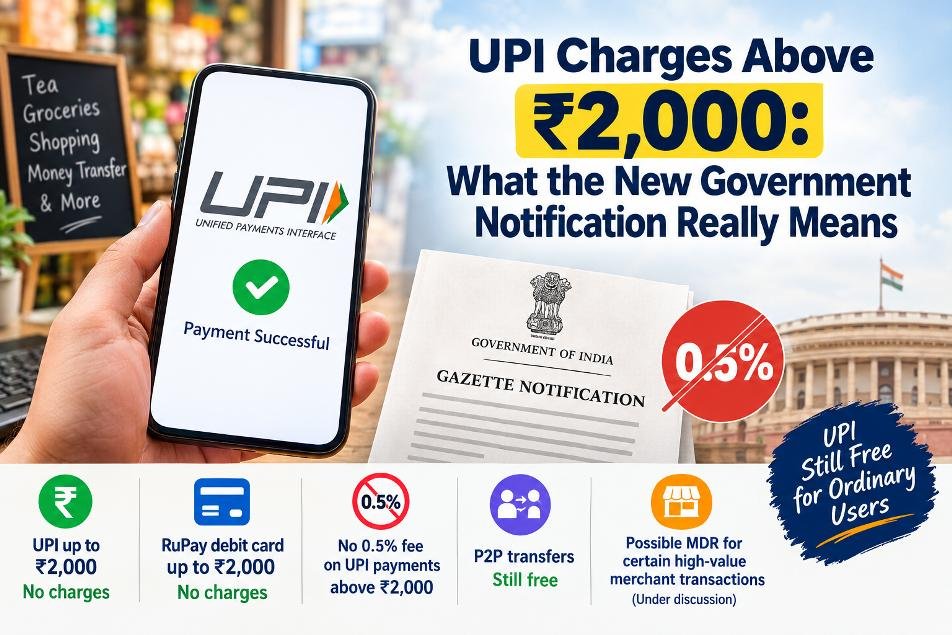
The notification specifically mentions a ₹2,000 threshold, raising questions about whether payments above this amount could attract a charge, including the widely discussed 0.5% fee.
The key point is that no new 0.5% consumer charge has been imposed on UPI payments above ₹2,000. The notification has instead triggered a broader debate over whether a Merchant Discount Rate (MDR) could eventually apply to certain high-value merchant transactions.
What does the new UPI notification say?
The September 14 notification prohibits banks and payment system providers from imposing charges on UPI transactions up to ₹2,000. The same no-charge provision applies to RuPay debit card digital payments up to ₹2,000.
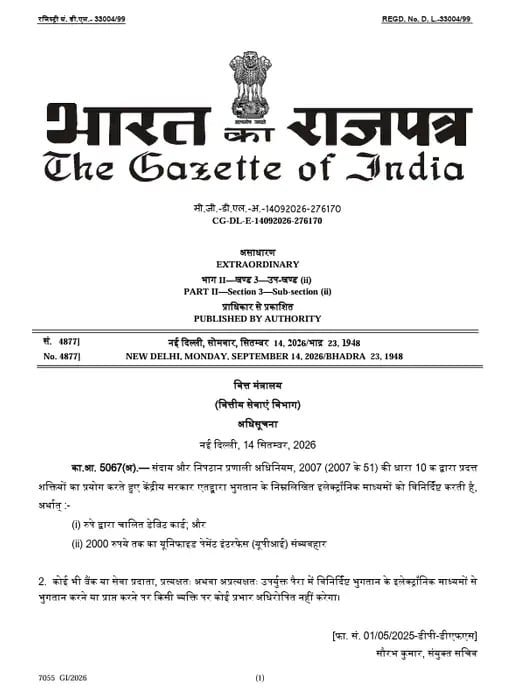
The notification does not announce a new fee for payments above ₹2,000, specify a 0.5% rate or provide an implementation date for such a charge.
The notification was issued under Section 10A of the Payment and Settlement Systems Act, 2007. Under the provision, banks, digital wallet companies and payment system providers cannot charge the payer or recipient for the specified payment methods within the notified limit.
Why has the ₹2,000 limit triggered controversy?
The specific ₹2,000 threshold has led to speculation that higher-value merchant transactions could eventually face a different charging mechanism.
This has also created confusion between a consumer fee and MDR. MDR is a charge associated with accepting digital payments and is generally part of the merchant-side cost involving banks, payment networks and payment service providers. A user charge, by contrast, would be directly collected from the person making the payment.
Has the 0.5% UPI charge been introduced?
No. The September 14 notification does not impose a 0.5% fee on every UPI payment above ₹2,000.
The 0.5% figure has emerged from the political debate. Congress has alleged that the government is preparing to impose a 0.5% charge on UPI transactions above ₹2,000. Under that calculation, a ₹5,000 payment would attract ₹25 and a ₹10,000 payment ₹50.
However, the notification does not prescribe this rate or state that users must pay it. Therefore, there is currently no 0.5% consumer charge on UPI payments above ₹2,000.
What has Congress alleged?
Congress has accused the government of preparing a mechanism to collect money through UPI and argued that the ₹2,000 threshold could provide a framework for introducing MDR on larger merchant transactions.
Leader of Opposition Rahul Gandhi has also criticised the move, arguing that even if customers are not directly charged, a merchant-side fee could eventually affect consumers through higher prices. He has pointed out that high-value UPI transactions may form a relatively small share of transaction numbers but account for a much larger share of total transaction value.
What have the government and BJP said?
The BJP has rejected the allegations and called claims about a new UPI charge misleading.
The government’s position remains that UPI will remain free for ordinary users, particularly for small-value payments made by consumers and small vendors. The current discussion is therefore about the possible future introduction of MDR for a limited category of high-value merchant transactions, not an immediate fee being deducted from users’ bank accounts.
Will P2P UPI transfers be charged?
There is no indication that ordinary person-to-person (P2P) UPI transfers will become chargeable.
Sending money to a friend, family member or another individual is different from making a merchant payment. The government’s stated position is that P2P UPI transfers will remain free, whether the amount is below or above ₹2,000.
Could MDR be introduced above ₹2,000?
This remains an open policy question.
The government has indicated that if MDR is brought back, it could be limited to certain larger merchant transactions rather than imposed universally. The September 14 notification sets no MDR rate or implementation date for payments above ₹2,000.
So, there is currently no confirmed 0.5% MDR applicable to all UPI payments above ₹2,000.
What is the government committee considering?
A 22-member UPI and Services Steering Committee, comprising representatives from banks, payment service providers and industry bodies, is expected to examine charges on higher-value merchant transactions.
The committee includes bodies such as the Indian Banks’ Association (IBA) and Payments Council of India (PCI). Its broader discussions involve the long-term financial sustainability of UPI, market expansion and the viability of digital payment infrastructure as transaction volumes grow.
Any MDR decision would be a separate policy development and should not be confused with the current notification.
What has Finance Minister Nirmala Sitharaman said?
Finance Minister Nirmala Sitharaman has previously stated that UPI payments for ordinary consumers should remain free.
The government’s position has also stressed protecting low-value payments, including those made to street vendors and small businesses. If MDR is eventually introduced, the indication is that it would apply only to specified categories of merchant transactions above a certain threshold rather than becoming a blanket UPI charge.
What does this mean for ordinary UPI users?
For now, ordinary users do not need to pay an additional 0.5% fee simply because a UPI payment exceeds ₹2,000.
The September 14 notification protects UPI transactions up to ₹2,000 from charges but does not impose a new fee on higher-value transactions. The confusion stems from the ₹2,000 threshold and the parallel discussion over possible future MDR for certain merchant payments.
In other words, a ₹2,001 or ₹10,000 UPI payment does not currently mean an automatic 0.5% deduction from the user’s bank account.
Bottom line
UPI has not become chargeable for ordinary users because a payment exceeds ₹2,000. There is currently no notification imposing a 0.5% fee on every UPI payment above that amount.
The issue under discussion is the possible future introduction of MDR for a limited category of high-value merchant transactions. Until a specific rate and implementation date are officially announced, users should not assume that a 0.5% UPI charge has been introduced.
For now, UPI remains free for ordinary users, while the debate over future merchant-side charges continues.