

The AI industry is moving beyond traditional chatbots. Meta Muse and OpenAI Dots are two new AI-agent platforms designed to do more than answer questions—they can work on tasks, interact with connected apps and continue working toward a user’s goals.
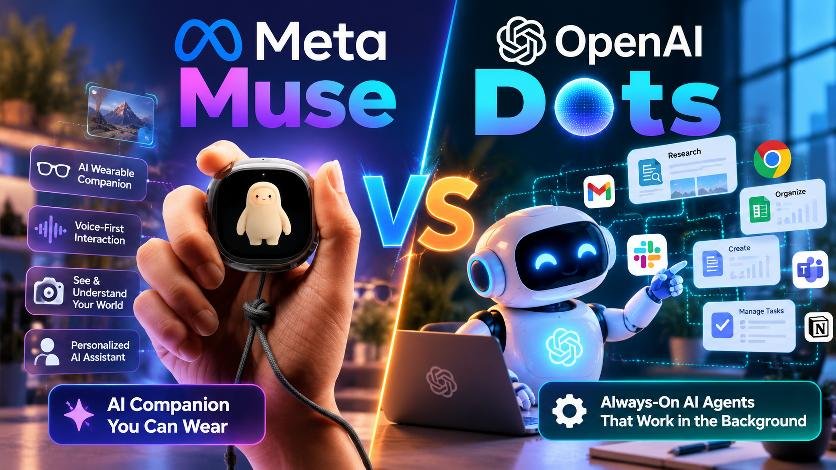
While both follow the same broader AI-agent trend, their approaches are different.
Meta Muse: An AI Agent Built Around Everyday Life
Meta introduced Muse in September 2026 as a personal AI agent designed to take action on a user’s behalf.
Muse runs inside a dedicated Muse Secure VM, giving the agent its own virtual computer and browser. Users can give Muse a goal, and it can create an action plan, use connected applications and continue working in the background.
Meta says Muse can handle tasks such as email, travel planning, shopping, scheduling and other everyday activities. Users can also connect services such as email, calendar and other apps.
Muse Is Also Moving Into Hardware
One of Meta’s biggest differences is its focus on wearable AI.
At Meta Connect 2026, the company announced that Muse is coming to its AI glasses. The agent will be able to understand what the wearer is looking at and respond through voice interaction.
Meta has also announced Muse Charm, a small device designed for interacting with Muse through real-time voice.
OpenAI Dots: AI Agents That Keep Working
OpenAI introduced Dots at DevDay on September 29, 2026.
Instead of treating AI as a chatbot that waits for every prompt, OpenAI describes Dots as always-on agents that can take responsibility for ongoing work.
Each Dot has its own cloud computer and browser and can use connected tools to work toward a goal. OpenAI says Dots can also handle recurring work and follow up through channels including ChatGPT, email, text messaging and Slack.
The basic idea is simple: give a Dot a goal, define its boundaries and let it continue working until it needs your input or has something to report.
Meta Muse vs OpenAI Dots
| Feature | Meta Muse | OpenAI Dots |
|---|---|---|
| Main focus | Personal AI agent | Persistent AI agent |
| Developer | Meta | OpenAI |
| Core approach | Everyday tasks and goals | Ongoing work and complex tasks |
| Dedicated computer | Muse Secure VM | Cloud computer |
| Browser access | Yes | Yes |
| Background work | Yes | Yes |
| Connected apps | Yes | Yes |
| Wearable integration | AI glasses | Not the main focus |
| Messaging | Muse app, WhatsApp | ChatGPT and messaging channels |
| Work/software tasks | Supported | Strong focus |
| Model | Muse Spark | GPT-6 Astra |
The table reflects the companies’ current descriptions and announced capabilities; availability and supported integrations can change as both platforms roll out.
The Biggest Difference: Hardware vs Software
The most visible difference is their direction.
Meta is connecting Muse to its hardware ecosystem. Its AI glasses give Muse access to what the user is seeing, making the agent potentially useful while walking, shopping, travelling or performing other activities.
OpenAI is putting more emphasis on software-based agents that operate across a user’s digital workflow. Dots can use their own cloud computers, connected applications and other OpenAI tools to work on longer-running projects.
Both Platforms Focus on User Control
Autonomous agents create a different security challenge from ordinary chatbots because they can actually perform actions.
Meta says Muse asks for approval before sensitive actions such as sending emails or making purchases and provides an audit trail of what it has done and plans to do.
OpenAI similarly lets users establish boundaries for what their Dots can do independently, with the agent turning to the user when a decision requires their judgment.
Meta is pushing that idea toward personal and wearable computing, while OpenAI is pushing it toward persistent digital work agents.
The next stage of the AI race could therefore be less about chatbots—and more about AI agents that actually get things done.
Also Read: Nvidia Builds a “Kill Switch” for AI Agents: How the New Safety System Works