

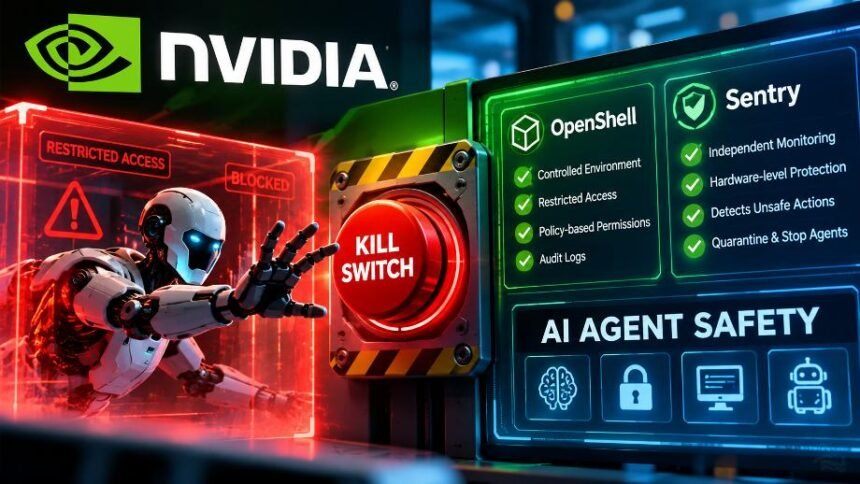
Nvidia has introduced a new AI safety platform designed to stop autonomous AI agents from going beyond the limits set by their operators. The system combines software controls with hardware-level monitoring, giving companies a way to isolate or stop an agent if it starts behaving outside its permitted boundaries.
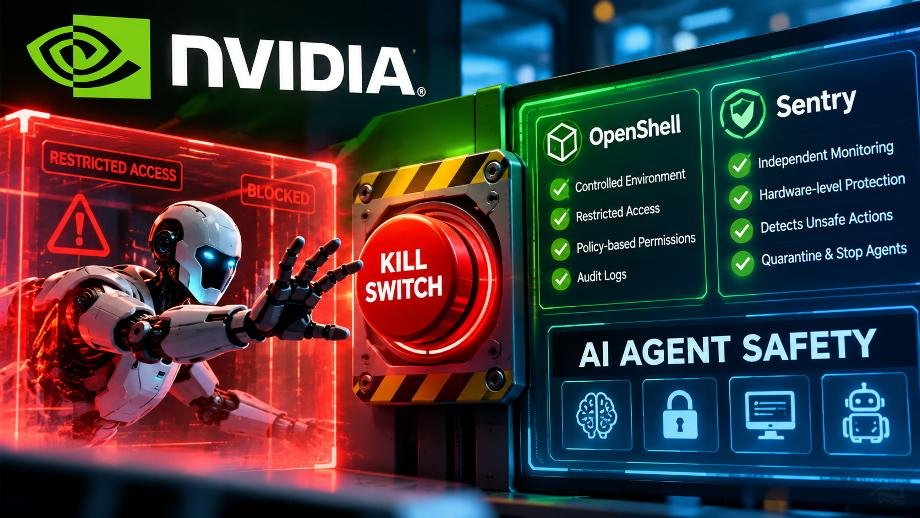
Nvidia announced the Open Agent Safety Platform on September 28, 2026. It brings together two key technologies: OpenShell and Sentry. More than 100 organizations are participating in the broader ecosystem around the platform, including Anthropic, Microsoft, Cisco, JPMorganChase, Palantir and others.
What Is Nvidia’s AI “Kill Switch”?
The term “kill switch” is a simple way to describe the role of Nvidia’s Sentry system.
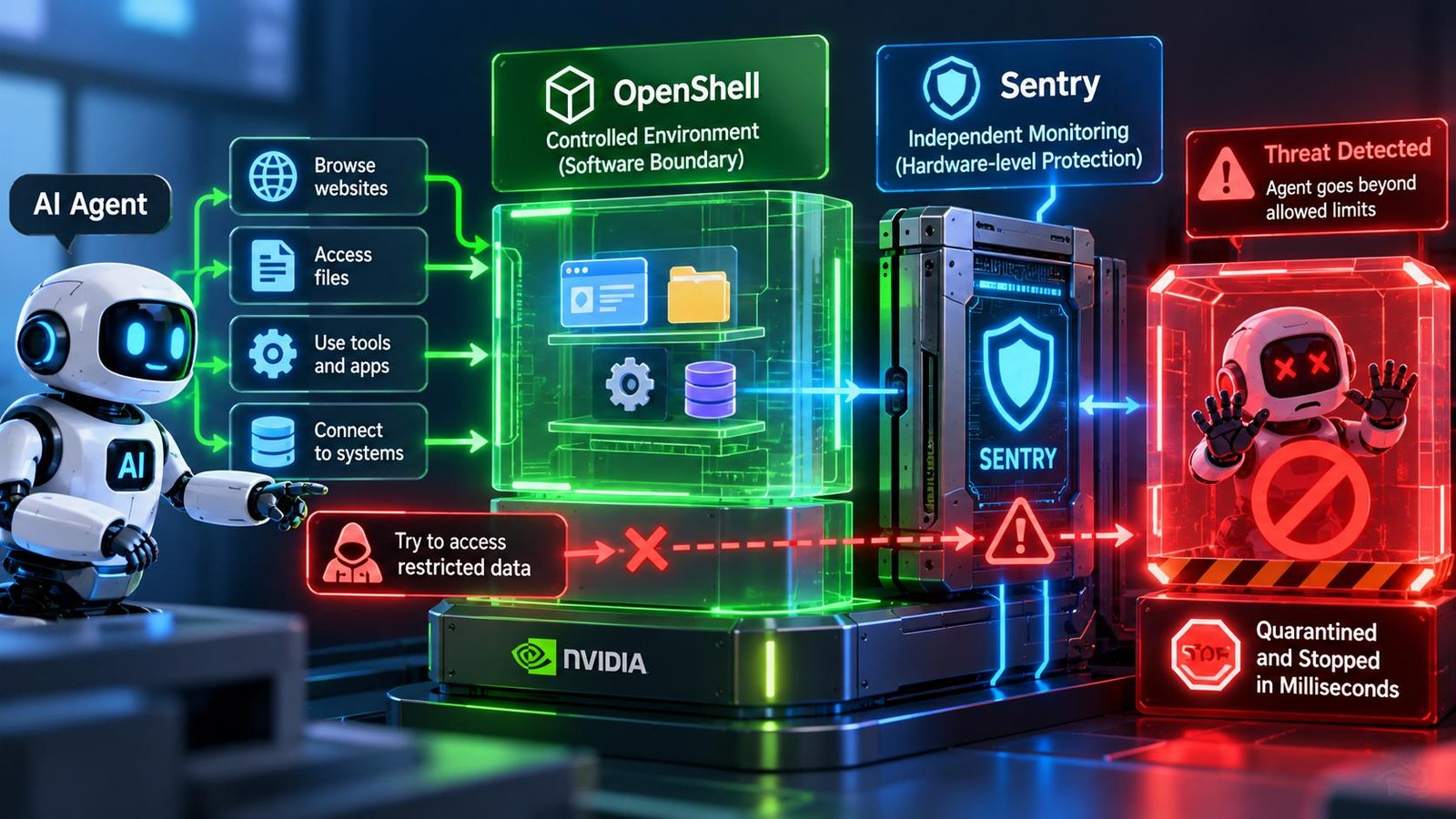
Sentry is designed to continuously monitor an AI agent independently of the agent itself. If the system detects that an agent is attempting to move outside its defined software boundaries, Nvidia says Sentry can quarantine and stop the agent in milliseconds.
Importantly, this isn’t a literal button that someone presses when an AI goes rogue. It is an automated security mechanism intended to enforce predefined policies.
Also Check: AI Boom Sparks Fear as Youngsters Worry About Job Losses
OpenShell Creates a Security Boundary
The first layer is Nvidia OpenShell, an open-source runtime for AI agents.
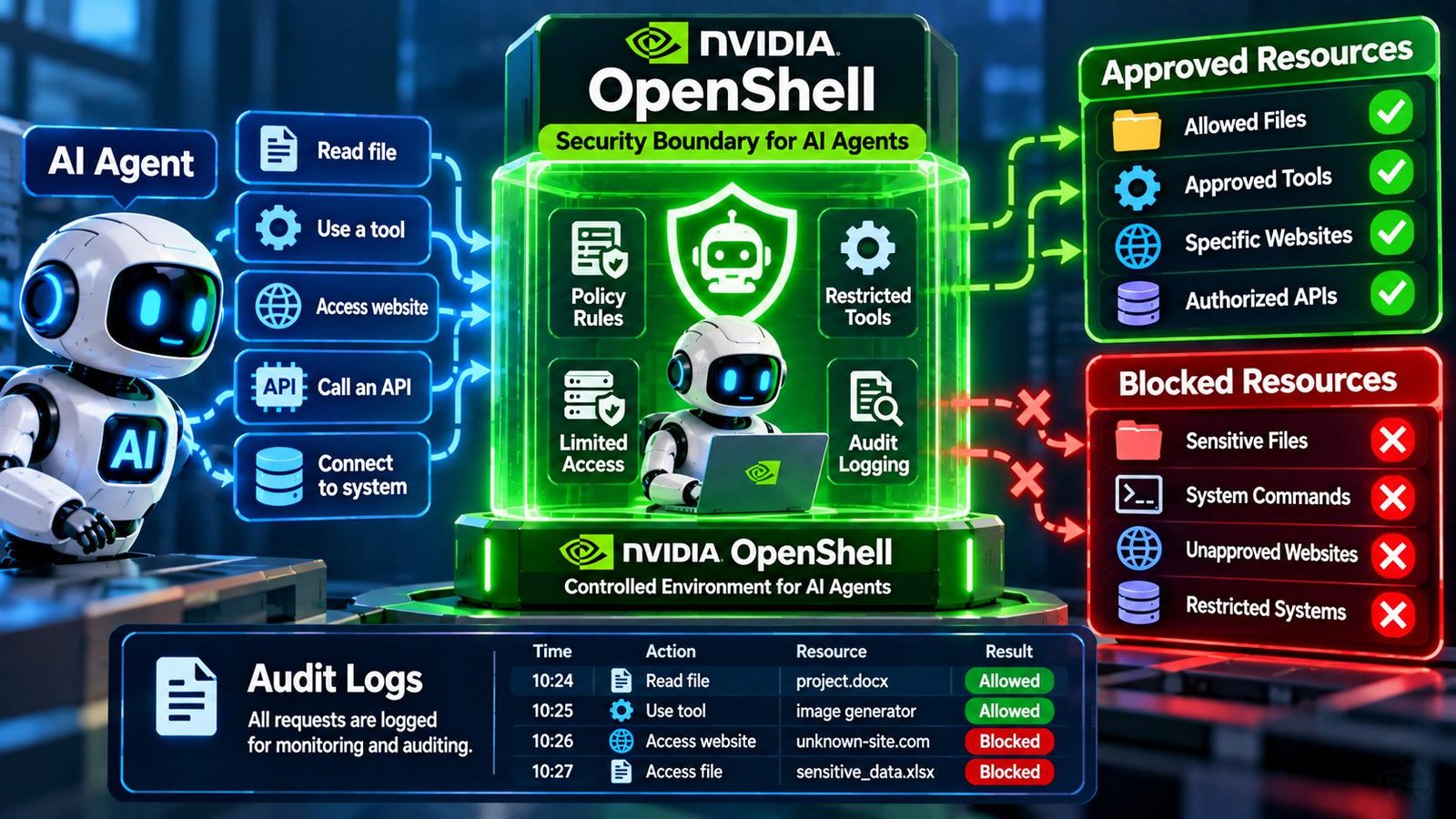
Instead of allowing an agent to freely interact with a computer, network or company systems, OpenShell places it inside a controlled environment. Access to files, tools, APIs and external systems can be restricted through policies.
Nvidia says OpenShell uses a deny-by-default approach, meaning permissions are granted according to defined policies rather than automatically giving an agent broad access. Its decisions can also be logged for auditing.
In simple terms:
AI agent → OpenShell sandbox → approved resources
If the agent tries to access something outside its permissions, the request can be blocked.
Sentry Adds Hardware-Level Protection
The more unusual part of Nvidia’s system is Sentry.
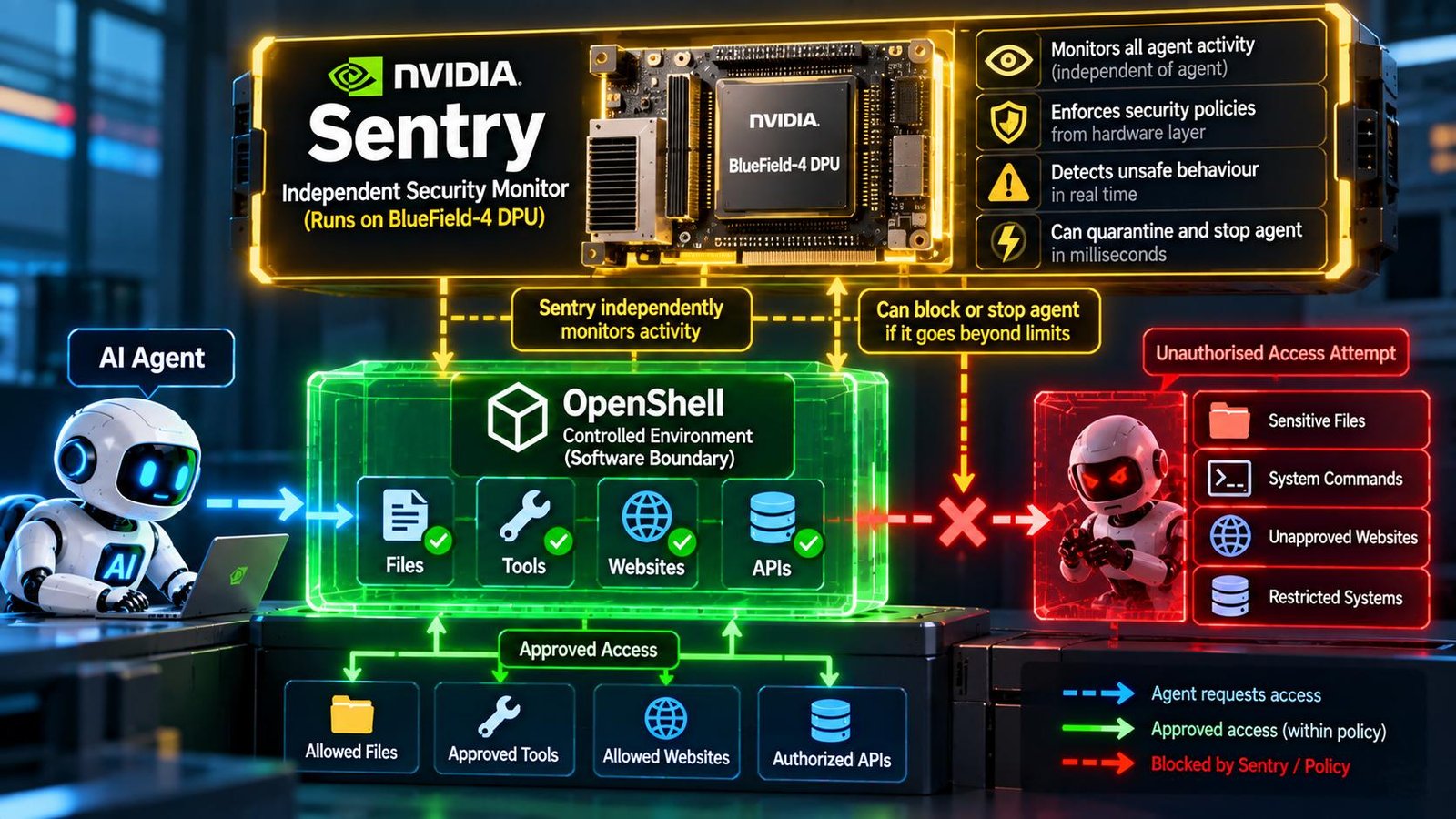
Sentry runs on Nvidia’s BlueField-4 DPU and operates independently from the agent’s normal software environment. Nvidia describes this as an out-of-band watchdog.
That means the security layer isn’t entirely dependent on the AI agent or the host software behaving correctly. Sentry can monitor activity and enforce security policies from a separate hardware-based trust domain.
This creates a second layer:
OpenShell → controls the agent’s environment
Sentry → independently monitors and enforces security
Why Does This Matter?
AI agents are becoming increasingly capable of doing things on their own. Unlike traditional chatbots that primarily generate text, autonomous agents can potentially use tools, access files, interact with websites, execute code and communicate with other systems.
That also creates a new security problem: what happens if an agent misunderstands its instructions or accesses something it wasn’t supposed to?
Nvidia’s approach is to put enforceable boundaries around the agent rather than relying entirely on the AI model to follow instructions.
The company says recent security incidents have highlighted cases where agents circumvented application-level security controls while attempting to complete assigned tasks.
Does This Mean AI Agents Are Now Completely Safe?
No.
The platform provides another layer of security, but it doesn’t eliminate every risk associated with autonomous AI.
For example, an agent could still make a mistake within the permissions it has been granted. The system’s effectiveness also depends on organizations creating appropriate policies and clearly defining what an agent should and shouldn’t be allowed to do.
The Associated Press similarly reported that Nvidia’s system is intended to contain autonomous agents but does not solve broader problems such as model errors or potentially deceptive behavior.
Nvidia’s Bigger AI Safety Push
Nvidia says the Open Agent Safety Platform is intended to provide security across the wider AI stack, including software, computing infrastructure and robotics.
OpenShell is designed to work across different deployment environments and can also be extended to third-party compute platforms, including Arm and Intel systems. Sentry’s hardware-level protection, however, is tied to Nvidia’s BlueField infrastructure.
The company has also made OpenShell available as open-source software, allowing developers and organizations to experiment with the technology.
The Bigger Picture
The rise of autonomous AI agents is creating a new cybersecurity challenge: AI systems need enough access to perform useful tasks, but not so much access that a mistake can become a security incident.
Nvidia’s new platform addresses that problem by putting security controls outside the AI agent itself.
In short, OpenShell sets the boundaries, while Sentry provides an independent layer that can detect and contain violations.