
Buying a new vehicle can sometimes feel like reading a technical manual. You see numbers such as 120 bhp, 200 Nm, 1,500cc, 180mm ground clearance and 0-100 km/h, followed by terms like DCT, CVT, ABS, AWD and ADAS.
- 1. BHP — Engine Power
- 2. Torque — Pulling Force
- 3. RPM — Revolutions Per Minute
- 4. Engine Displacement — CC or Litres
- 5. 0–100 km/h
- 6. Top Speed
- 7. Power-to-Weight Ratio
- 8. Kerb Weight
- 9. Ground Clearance
- 10. Wheelbase
- 11. Boot Space
- 12. Transmission
- 13. FWD — Front-Wheel Drive
- 14. RWD — Rear-Wheel Drive
- 15. AWD — All-Wheel Drive
- 16. 4WD — Four-Wheel Drive
- 17. Mileage / Fuel Efficiency
- 18. Hybrid
- 19. Regenerative Braking
- 20. EV — Electric Vehicle
- 21. ABS
- 22. ESC
- 23. ADAS
- 24. Airbags
- 25. Tyre Size
- 26. Turbocharger
- 27. Naturally Aspirated Engine
- 28. Torque Converter
- 29. Ground Clearance vs Wheelbase: Why Both Matter
- Why These Terms Matter When Buying a Car
- Final Takeaway
But what do all these terms actually mean?
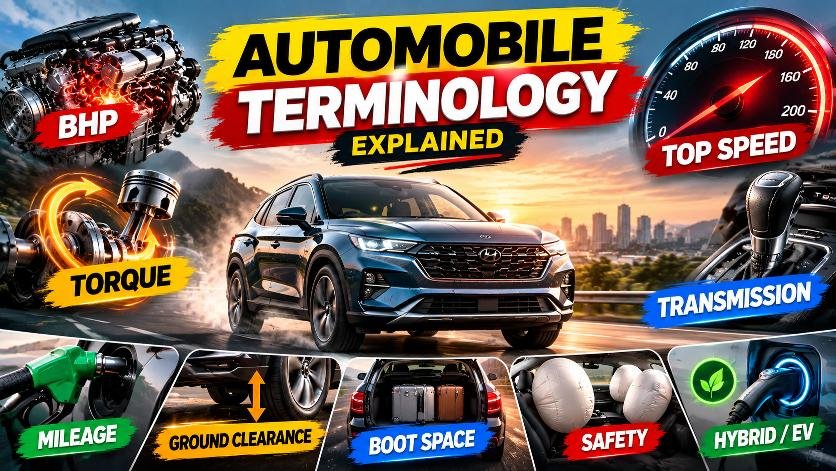
You don’t need to be a mechanic to understand them. Knowing some basic automobile terminology can help you compare vehicles, understand reviews, and figure out which specifications actually matter for your driving needs.
Here are some of the most common vehicle terms explained in simple language.
1. BHP — Engine Power
BHP, or brake horsepower, is a measurement of power output.
In simple terms, it indicates how much power an engine can produce. It is one of the figures commonly used to describe a car’s performance.
A car with higher BHP may have stronger high-speed performance, but BHP alone doesn’t determine how fast a car is. Weight, gearing, aerodynamics, traction and the transmission also matter.
Example: A lightweight car with 120 bhp can feel quicker than a much heavier car with the same power.
2. Torque — Pulling Force
Torque is measured in Newton-metres (Nm).
It represents rotational force and is particularly important for acceleration from lower speeds, climbing inclines and carrying or pulling heavier loads.
For everyday driving, torque is one reason a car can feel strong when accelerating without needing very high engine speeds.
Example: An SUV with 300 Nm of torque may feel strong when accelerating at low or medium speeds.
However, higher torque doesn’t automatically mean a car is faster overall. Power, gearing, weight and traction also influence performance.
3. RPM — Revolutions Per Minute
RPM stands for Revolutions Per Minute.
It tells you how quickly the engine is rotating.
When you accelerate, engine RPM rises. Your car’s power and torque are produced across different RPM ranges, which is why the engine can feel different at low and high speeds.
For example, a car may produce its maximum torque at a relatively low RPM and maximum power at a higher RPM.
4. Engine Displacement — CC or Litres
Engine displacement is usually expressed in cc or litres.
A 1,000cc engine is commonly described as a 1.0-litre engine, while 1,500cc is generally called 1.5 litres.
Displacement represents the combined swept volume of the engine’s cylinders.
However, engine size alone doesn’t tell you how powerful a car will be.
Turbocharging, engine design, hybrid assistance and other technologies can allow a smaller engine to produce substantial power.
5. 0–100 km/h
This figure tells you how quickly a car can accelerate from a standstill to 100 km/h.
For example:
0–100 km/h: 9.5 seconds
means the car takes approximately 9.5 seconds to reach 100 km/h under the stated testing conditions.
It is a useful performance comparison, but real-world acceleration can vary depending on road conditions, tyres, fuel load, temperature and driving conditions.
6. Top Speed
Top speed is the maximum speed a vehicle can reach under specified conditions.
A higher top speed doesn’t necessarily mean a car will feel faster during normal driving.
For everyday use, acceleration, gearing, vehicle weight and drivability can be more relevant than the absolute top-speed figure.
7. Power-to-Weight Ratio
This compares a car’s power with its weight.
A lighter car with the same engine power generally has a higher power-to-weight ratio than a heavier car.
That’s one reason two cars with similar BHP figures can deliver noticeably different acceleration.
8. Kerb Weight
Kerb weight refers to the weight of a vehicle in a specified ready-to-drive condition, generally including standard fluids and fuel but excluding passengers and luggage. Definitions can vary slightly between manufacturers and markets.
Weight affects several aspects of a car, including acceleration, braking, handling and efficiency.
9. Ground Clearance
Ground clearance is the distance between the road surface and the lowest part of the vehicle’s underside.
It is particularly relevant in India because cars regularly encounter speed breakers, uneven roads and rough surfaces.
Higher ground clearance can provide more underbody clearance, although it is only one factor affecting a vehicle’s suitability for rough roads.
10. Wheelbase
Wheelbase is the distance between the front and rear axles.
A longer wheelbase can contribute to greater cabin space and can influence ride and stability characteristics.
This is why wheelbase is an important specification when comparing similarly sized cars.
11. Boot Space
Boot space refers to the amount of luggage capacity available in a car.
It is generally measured in litres.
A larger number doesn’t always mean the boot will be more useful because the shape and accessibility of the luggage area also matter.
12. Transmission
The transmission transfers engine power to the driven wheels and uses different ratios to help the vehicle operate across a range of speeds.
Common transmission types include:
- Manual
- AMT
- CVT
- Torque Converter Automatic
- DCT
Each has a different driving experience and set of advantages and trade-offs.
(a.) AMT
Automated Manual Transmission is essentially a manual gearbox in which the clutch and gear changes are operated automatically.
AMTs are generally associated with affordable automatic cars, although gear changes can feel less smooth than some other automatic systems.
(b.) CVT
A Continuously Variable Transmission doesn’t use conventional fixed gear steps in the same way as a traditional automatic.
It continuously varies the drive ratio, which can provide smooth acceleration.
(c.) DCT
A Dual-Clutch Transmission uses two clutches, generally allowing the next gear to be prepared in advance for rapid gear changes.
DCTs are often associated with quick shifts and sporty driving characteristics.
(d.) Torque Converter Automatic
This is a conventional type of automatic transmission that uses a torque converter to transfer power between the engine and transmission.
13. FWD — Front-Wheel Drive
FWD means the front wheels receive power from the engine.
It is common in hatchbacks, sedans and many modern SUVs.
FWD layouts can offer packaging and efficiency advantages and are widely used in everyday passenger cars.
14. RWD — Rear-Wheel Drive
RWD sends power to the rear wheels.
It is commonly found in certain performance cars, larger vehicles and some SUVs and utility vehicles.
The layout can provide particular handling and load-carrying characteristics.
15. AWD — All-Wheel Drive
AWD means the vehicle can send power to all four wheels through its drivetrain system.
The system can help improve traction in appropriate conditions.
However, AWD does not automatically make a vehicle an off-road vehicle. Tyres, ground clearance, suspension, gearing and the specific AWD system also matter.
16. 4WD — Four-Wheel Drive
4WD is generally associated with systems designed for demanding terrain and off-road use.
Depending on the vehicle, 4WD systems can provide different drive modes and gear ratios to improve traction on difficult surfaces.
AWD and 4WD are sometimes used interchangeably in casual conversation, but they can refer to different drivetrain systems.
17. Mileage / Fuel Efficiency
Mileage usually refers to how far a vehicle can travel using a given amount of fuel.
In India, it is commonly expressed as km/l.
The mileage figure advertised by a manufacturer is generally based on standardized testing, while actual mileage depends on traffic, driving style, road conditions, load, weather and vehicle condition.
18. Hybrid
A hybrid vehicle combines an internal-combustion engine with electric propulsion.
Different hybrid systems work in different ways. Some provide limited electric assistance, while strong hybrids can drive using electric power under certain conditions.
Hybrid technology can improve fuel efficiency, particularly in stop-and-go driving, depending on the system and driving conditions.
19. Regenerative Braking
Regenerative braking is commonly found in hybrids and EVs.
When the vehicle slows down, the electric motor can operate as a generator and recover some of the vehicle’s kinetic energy.
That energy can then be stored in the battery for later use.
20. EV — Electric Vehicle
An EV, or electric vehicle, uses an electric motor for propulsion and stores energy in a battery.
Instead of an engine producing power through combustion, an EV uses electrical energy supplied to the motor.
EV specifications commonly include battery capacity, motor power, torque, range and charging speed.
21. ABS
ABS stands for Anti-lock Braking System.
During hard braking, ABS helps prevent the wheels from locking up completely, helping the driver maintain steering control while braking.
If you feel the brake pedal pulsating during emergency braking in a car equipped with ABS, that can be part of the system’s operation.
22. ESC
Electronic Stability Control, commonly called ESC, helps the vehicle maintain stability when it detects conditions such as a loss of directional control.
The system can selectively intervene through braking and/or engine control to help the driver maintain the intended path.
23. ADAS
ADAS stands for Advanced Driver Assistance Systems.
It covers technologies designed to assist the driver, such as:
- Adaptive cruise control
- Lane departure warning
- Lane keeping assistance
- Forward collision warning
- Automatic emergency braking
- Blind-spot monitoring
ADAS is designed as a driver-assistance technology. It does not turn a conventional car into a fully autonomous vehicle.
24. Airbags
Airbags are supplemental restraint systems designed to provide additional protection during certain crashes.
Modern cars can have multiple airbags, including front, side and curtain airbags depending on the model and variant.
The number and type of airbags can therefore be an important safety specification when comparing cars.
25. Tyre Size
You may see a tyre specification such as:
195/65 R15
These numbers describe different characteristics of the tyre.
- 195 = tyre width in millimetres
- 65 = aspect ratio
- R = radial construction
- 15 = wheel diameter in inches
Understanding tyre size can help you compare wheel and tyre configurations between different variants.
26. Turbocharger
A turbocharger uses exhaust gases to drive a turbine that helps force more air into the engine.
More air allows the engine to burn more fuel efficiently and can help produce more power from a given engine size.
This is one reason modern smaller turbocharged engines can produce considerably more power than their naturally aspirated counterparts.
27. Naturally Aspirated Engine
A naturally aspirated engine does not use a turbocharger or supercharger to force air into the engine.
Air enters the engine primarily through atmospheric pressure and the engine’s intake system.
These engines can offer a different power-delivery character compared with turbocharged engines.
28. Torque Converter
A torque converter is a fluid coupling used in many automatic transmissions.
It allows the engine to keep running while the vehicle is stationary and helps transmit engine power to the transmission.
It is one of the components that distinguishes traditional torque-converter automatic transmissions from systems such as AMTs and DCTs.
29. Ground Clearance vs Wheelbase: Why Both Matter
These two terms are often confused.
Ground clearance tells you how much space exists between the road and the vehicle’s lowest point.
Wheelbase tells you the distance between the front and rear axles.
A vehicle can have high ground clearance without having an especially long wheelbase, and vice versa.
Why These Terms Matter When Buying a Car
You don’t need to memorize every specification.
Instead, focus on the numbers that match your requirements.
For example:
Mostly city driving:
Look at fuel efficiency, transmission, dimensions, turning radius and low-speed drivability.
Highway driving:
Pay attention to power, torque, stability, comfort, braking and safety features.
Family use:
Consider cabin space, wheelbase, boot capacity, safety equipment and ease of access.
Rough roads:
Ground clearance, tyres, suspension and underbody protection can become more important.
Performance driving:
BHP, torque, power-to-weight ratio, transmission, tyres and braking performance deserve closer attention.
Final Takeaway
Automobile terminology can initially look complicated, but most of these terms describe relatively simple things.
BHP tells you about power. Torque tells you about rotational force. RPM tells you how fast the engine is spinning. Ground clearance tells you how much space exists beneath the vehicle. Wheelbase tells you the distance between the axles. Transmission tells you how power is delivered to the wheels.
Once you understand these basics, comparing vehicles becomes much easier — and specification sheets start looking far less confusing.