

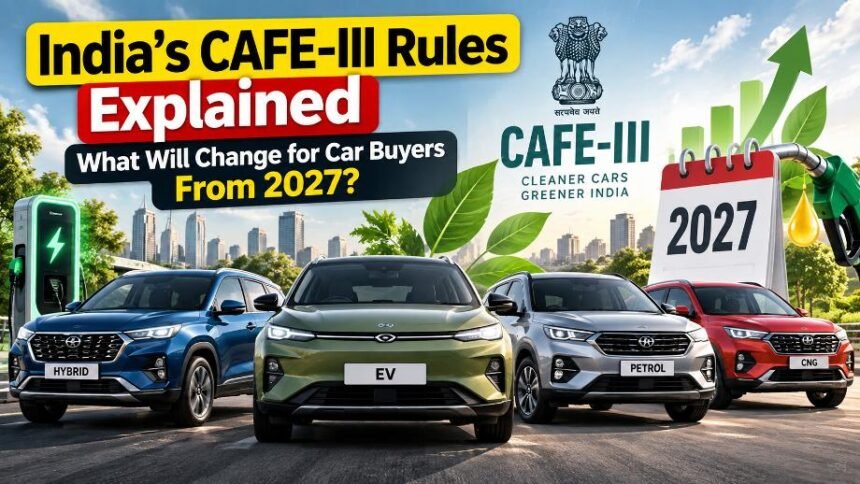
India is preparing for a major shift in the way carmakers manage fuel efficiency and emissions. The government has notified the third phase of Corporate Average Fuel Economy (CAFE-III) norms, which will apply to eligible passenger vehicles from April 1, 2027, through March 31, 2032.
The rules are aimed at gradually reducing fleet-wide fuel consumption and CO₂ emissions while giving automakers more incentives to sell electric, hybrid and alternative-fuel vehicles.
But what does this mean for people planning to buy a car?
What Are CAFE-III Rules?
CAFE rules don’t set a direct fuel-efficiency limit for every individual car. Instead, they look at the average fuel consumption of a manufacturer’s eligible passenger-vehicle fleet.
This means a carmaker can sell some higher-consuming vehicles while offsetting their impact with more efficient models such as EVs and hybrids.
Under CAFE-III, the permitted fleet-average fuel consumption becomes progressively stricter each year. For a manufacturer with a reference fleet weight of 1,229kg, the benchmark falls from 3.996 litres per 100km in FY2027-28 to 3.3273 litres per 100km in FY2031-32.
EVs Get the Biggest Compliance Boost
One of the most important changes is the increased importance of electrified vehicles.
Under the final framework, battery-electric and range-extended electric vehicles receive a 3.0 super-credit multiplier. Plug-in hybrids and flex-fuel strong hybrids receive 2.5, while strong hybrids receive 1.6.
In simple terms, selling cleaner vehicles can provide manufacturers with additional compliance benefits.
This could encourage automakers to introduce more EVs, hybrids and other low-emission powertrains over the next few years.
Could More Hybrid Cars Arrive?
Quite possibly.
CAFE-III gives strong hybrids a compliance benefit, although the multiplier is lower than the one given to pure EVs.
This could encourage manufacturers that already have hybrid technology to expand their hybrid line-ups. Buyers could therefore see more petrol-hybrid SUVs, sedans and other models arriving in Indian showrooms.
What About Petrol and Diesel Cars?
Petrol and diesel cars aren’t disappearing because of CAFE-III.
Instead, manufacturers have several ways to improve their fleet performance, including more efficient engines, hybrid systems, better transmissions, regenerative braking and other efficiency technologies.
CAFE-III allows manufacturers to claim benefits for certain qualifying efficiency technologies, with the combined technology benefit capped at 9g CO₂/km.
Will Car Prices Increase?
There is no blanket CAFE-III price increase announced for consumers.
However, automakers may need to invest more in efficient engines, hybrid systems, lightweight materials and other technologies to meet their fleet targets.
Depending on how manufacturers pass those costs through, some vehicles could become more expensive.
At the same time, better fuel efficiency could potentially reduce running costs for buyers over the life of a vehicle.
CNG and Ethanol Also Get Benefits
CAFE-III isn’t limited to EVs and hybrids.
The framework provides carbon-neutrality benefits for certain alternative fuels. CNG, ethanol and other qualifying fuel technologies can therefore provide manufacturers with additional compliance routes.
This means India’s future car market could see a combination of EVs, hybrids, CNG vehicles and higher-ethanol-compatible vehicles, rather than a single technology replacing everything else.
A New Testing System Is Also Coming
Another important change for buyers is the move toward WLTP reporting.
For models sold from April 1, 2027, manufacturers will have to declare performance under both the existing MIDC system and WLTP, with the latter designed to provide a different and generally more representative testing framework.
This could make official efficiency and emissions figures more informative when comparing future cars.
What Does CAFE-III Mean for Car Buyers?
For consumers, the biggest impact may not be one sudden change in 2027. Instead, CAFE-III could gradually influence which cars manufacturers develop and sell in India.
Over the next five years, buyers could see:
- More hybrid cars and SUVs
- More EV options
- Greater focus on fuel efficiency
- More advanced engine and transmission technology
- Greater use of efficiency features
- More attention to alternative fuels
- Changes in how manufacturers report vehicle efficiency
The Bottom Line
CAFE-III is primarily a regulation for automakers, not a new rule telling consumers which type of car they must buy.
But its effects could gradually reach showrooms. As manufacturers work toward increasingly strict fleet-average targets between 2027 and 2032, electrification, hybrid technology and fuel efficiency are likely to become increasingly important parts of India’s new-car market.